
Resources and News from Mobility Plus Buford, GA
Total: 21 articles
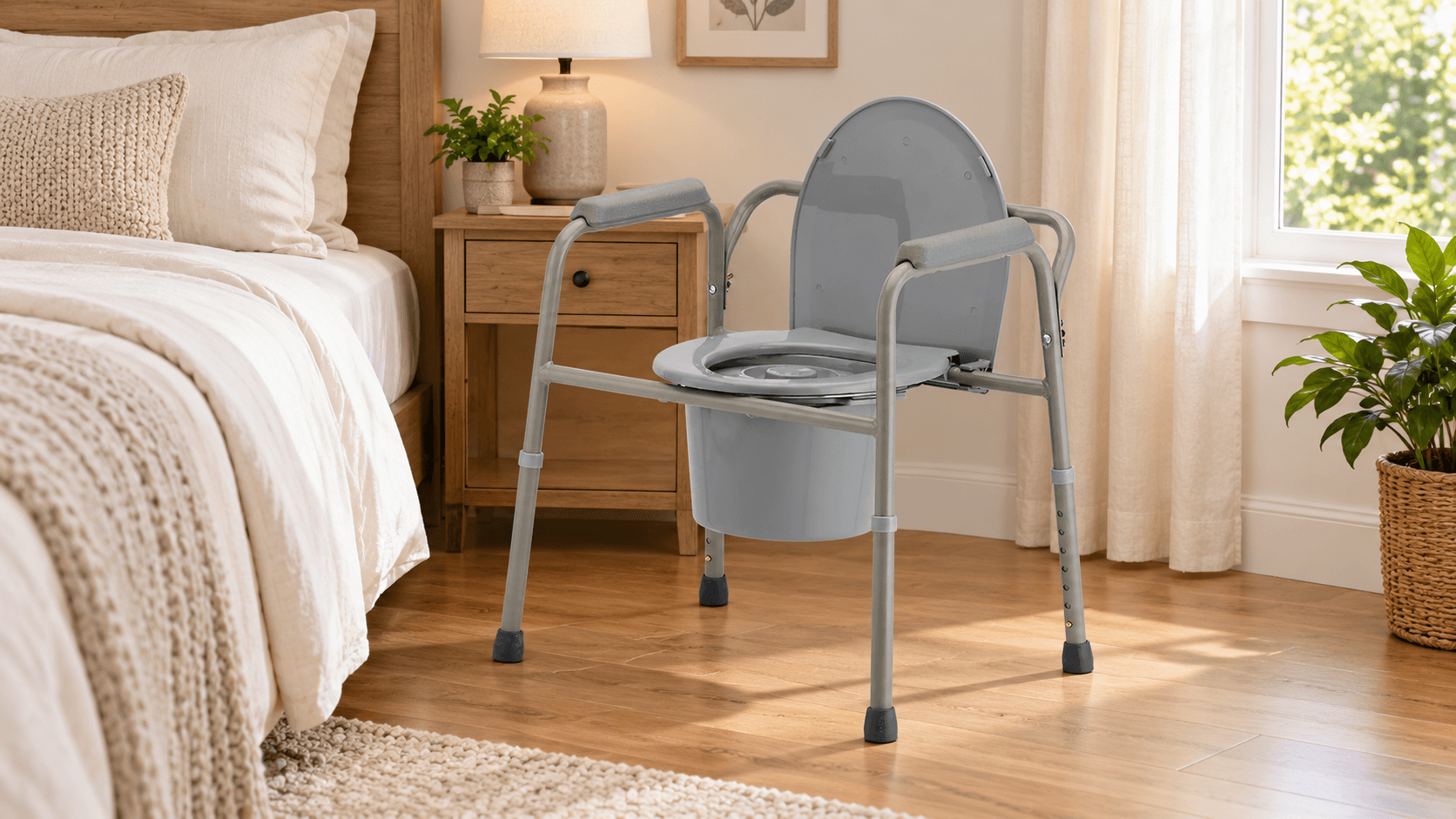
Raised Toilet Seat or Bedside Commode: Which Makes More Sense at Home?
The bathroom may be only a few steps away, yet using the toilet can still be a challenge. For one person, the low seat is the hardest part. For another, getting to the bathroom at night is exhausting. A raised toilet seat and a bedside commode address different parts of that routine.
Is the difficulty sitting and standing, reaching the bathroom, or both?
Raised Toilet Seat: Help at the Existing Toilet
A raised toilet seat adds height, reducing how far someone has to lower themselves and rise. It may suit a person who can reach the bathroom but finds the toilet too low. Some models include arms for
support.
Fit comes first. Check the bowl shape, dimensions and mounting method; a product described as fitting most toilets still has limits.
Bedside Commode: Bring Toileting Closer
A bedside commode is a freestanding toilet chair with a removable collection bucket. It may be worth considering when walking to the bathroom is difficult, particularly overnight or during recovery.
Plan for a stable, level location, privacy, room for assistance and someone to empty and clean the bucket. Someone who needs help getting on and off will still need that assistance beside the bed.
A 3-in-1 Commode Can Serve More Than One Purpose
Some 3-in-1 commodes work beside the bed, over a toilet as an elevated seat, or as a toilet safety frame. Use only the configurations and parts specified by the manufacturer. Check toilet clearance and floor space before counting on one product for both locations.
Choose the Fit, Not Just the Added Height
The finished seat height, room between the arms and weight capacity must suit the person. Follow installation instructions and check that the seat or frame is secure before use. If standing or transfers require assistance, ask an occupational therapist or other clinician about suitable height and support.
Before You Choose
- Note toilet shape, existing seat height and available floor space.
- Have the user's weight and any care-team recommendations ready.
- Discuss who will help with transfers, emptying and cleaning.
The Biggest Difference
A raised seat changes the height of an existing toilet. A bedside commode changes where toileting takes place. Choose around the task that needs help.
Browse Buford's commode selection, then call Mobility Plus Buford at (770) 800-6681 to discuss your home setup. Bring toilet photos and measurements, and confirm which options are available before visiting.
10/15/2026
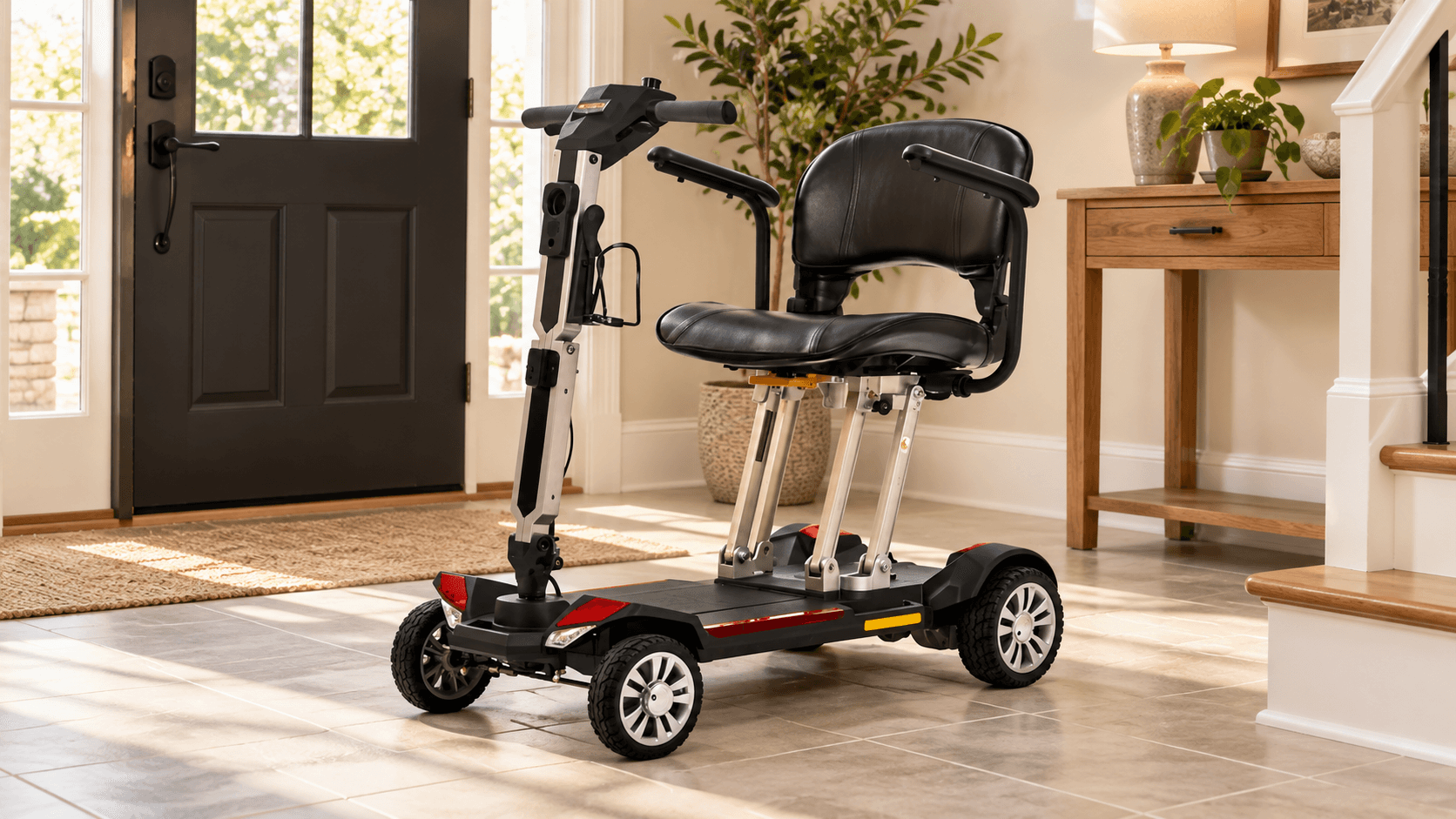
Can You Repair a Mobility Scooter Bought Online or Somewhere Else?
Your scooter stops working, and the company that sold it is several states away. Before arranging a shipment or ordering another battery, it is worth asking whether a local service team can help.
Mobility Plus Buford services equipment purchased elsewhere when the necessary parts can be sourced. That is a useful starting point, but it is not a promise that every brand or repair can be accepted.
The deciding question: can the exact scooter be assessed and the correct replacement parts obtained? Where you bought it is only part of the conversation.
Identify the scooter before bringing it in
Have the brand, model and serial number ready. A clear photo of the identification label is more useful than describing the scooter by its color. Golden's support guidance asks owners to provide a serial number for repair and warranty questions; the label location varies by model.
Call first, especially for an older model or an unfamiliar online brand. Confirm whether the shop can assess it before arranging transport.
Describe what changed, not what you think failed
Does it refuse to turn on, lose power during use, or show a warning light? Note when the problem began, any recent damage and which charger you use. Do not buy replacement parts based on a guess.
Follow the exact owner's manual for basic checks. If movement or braking is unreliable, stop using the scooter and ask for service guidance rather than testing it on an outing.
Check warranty arrangements separately
A local repair appointment and a warranty claim are not necessarily the same thing. Keep the receipt and warranty documents, and check with the original seller or manufacturer about the required process. Pride, for example, directs owners to authorized providers for service. Do not assume another shop's assessment or labor will be covered.
Ask what the estimate includes
Before authorizing work, ask about assessment charges, parts, labor and any pickup or return arrangements. Confirm timing after the problem and parts availability are clearer. If transport is difficult, ask whether service at home or collection is possible and what distance-based trip fees apply.
Before you call
- Brand, model and serial-number photo
- Symptoms, warning lights and charger details
- Receipt and any warranty paperwork
The Takeaway
Buying elsewhere does not automatically rule out local help. Confirm repairability before spending money on parts or transportation.
Call Mobility Plus Buford at (770) 800-6681 or review our services. Explain the problem and ask about the next step for your particular scooter.
10/14/2026
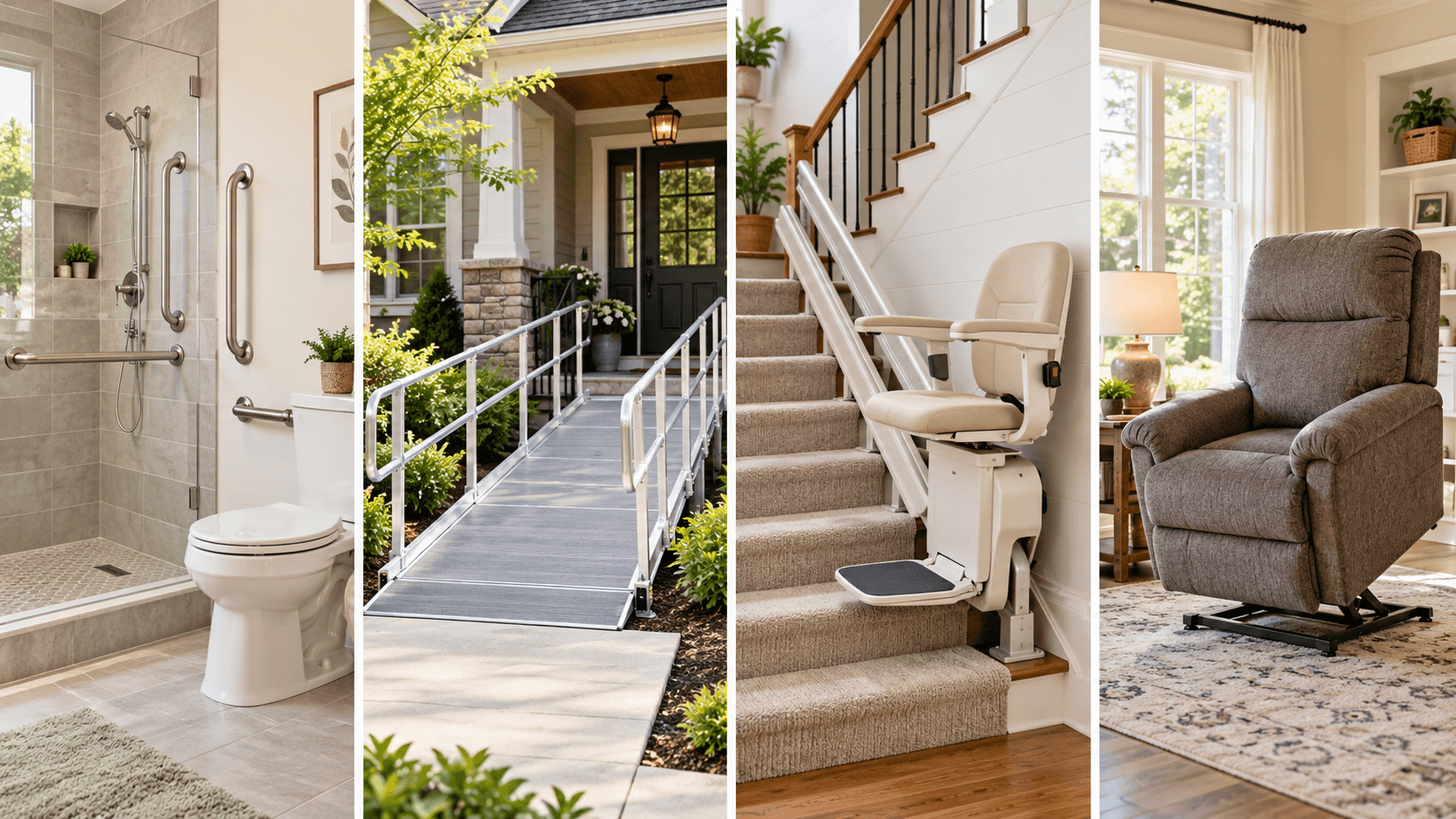
Grab Bars, Ramps, Stair Lifts, or Lift Chairs: Where Should You Start?
When mobility becomes more difficult at home, many families ask the same question: What should we get first? The answer depends on where the difficulty is happening and what activity feels unsafe, painful, or difficult. Some people struggle in the bathroom. Others have trouble getting in and out of the house, using the stairs, or standing up from a chair.
A good place to start is not with the product - it's with the daily challenge.
Start With the Biggest Safety Risk
Before choosing equipment, ask where the person feels most unstable, what part of the day is most difficult, whether the concern is fall prevention, getting up more easily, or accessing part of the home, and whether the need is temporary or long-term. The best first solution is usually the one that improves everyday safety and independence right away.
When Grab Bars May Be the Best Place to Start
If the biggest concern is bathroom safety, grab bars are often one of the simplest and most effective starting points. They may help with stepping into or out of the shower, lowering onto or rising from the toilet, balancing in a wet bathroom, and moving safely in a small space.
Start with grab bars if the main issue is balance and stability in the bathroom.
When a Ramp May Be the Best Place to Start
If the challenge is getting into or out of the home, a ramp may be the priority. A ramp may make sense for front porch steps, garage entry steps, raised thresholds, or when a wheelchair, walker, or scooter needs a safer path through the entrance. Whether the best choice is a threshold ramp, folding ramp, portable solid ramp, or modular ramp depends on the rise, available space, and how often the ramp will be used.
Start with a ramp if the main problem is entering or exiting the home safely.
When a Stair Lift May Be the Best Place to Start
If stairs inside the home are becoming unsafe or exhausting, a stair lift may be the most important first step. It may be worth considering when someone avoids going upstairs or downstairs, when stairs cause pain, fatigue, or fear of falling, or when important rooms are located on another level.
Start with a stair lift if the stairs are the main barrier inside the home.
When a Lift Chair May Be the Best Place to Start
If someone struggles most with sitting down or standing up, a lift chair may be the easiest place to begin. It can help when standing from a recliner or sofa is difficult, when lowering into a seated position is uncomfortable, or when the person spends a lot of time in one chair and needs both comfort and safer transfers.
Start with a lift chair if standing up from a seated position is the biggest daily struggle.
A Simple Way to Decide
Bathroom safety problem? -> Grab Bars
Trouble getting in or out of the house? -> Ramp
Stairs are becoming unsafe? -> Stair Lift
Trouble standing up from a chair? -> Lift Chair
Sometimes the right answer is not just one product. A person may need grab bars in the bathroom and a lift chair in the living room, or a ramp outside and a stair lift inside. The goal is to start with the solution that addresses the greatest daily obstacle first.
Think About Today - and What May Be Needed Next
It is also smart to think beyond the current problem. Consider whether mobility is likely to improve, stay the same, or decline; whether the person may begin using a walker, scooter, or wheelchair; whether a caregiver will be helping more in the future; and whether the goal is short-term recovery or long-term aging in place.
At Mobility Plus Buford
At Mobility Plus Buford, we usually recommend starting with the part of the home that creates the greatest safety risk or daily frustration. For some people, that means starting with grab bars. For others, it may be a ramp, stair lift, or lift chair. The right tarting point is the one that makes daily life safer, easier, and more comfortable right away.
The Bottom Line
If you are not sure where to start, do not begin with the product - begin with the problem. Grab bars help with bathroom safety. Ramps help with home entry. Stair lifts help with stairs. Lift chairs help with sitting and standing. Once you identify the biggest obstacle, it becomes much easier to choose the right solution.
The best first step is the one that removes the biggest barrier to safe daily living
10/09/2026
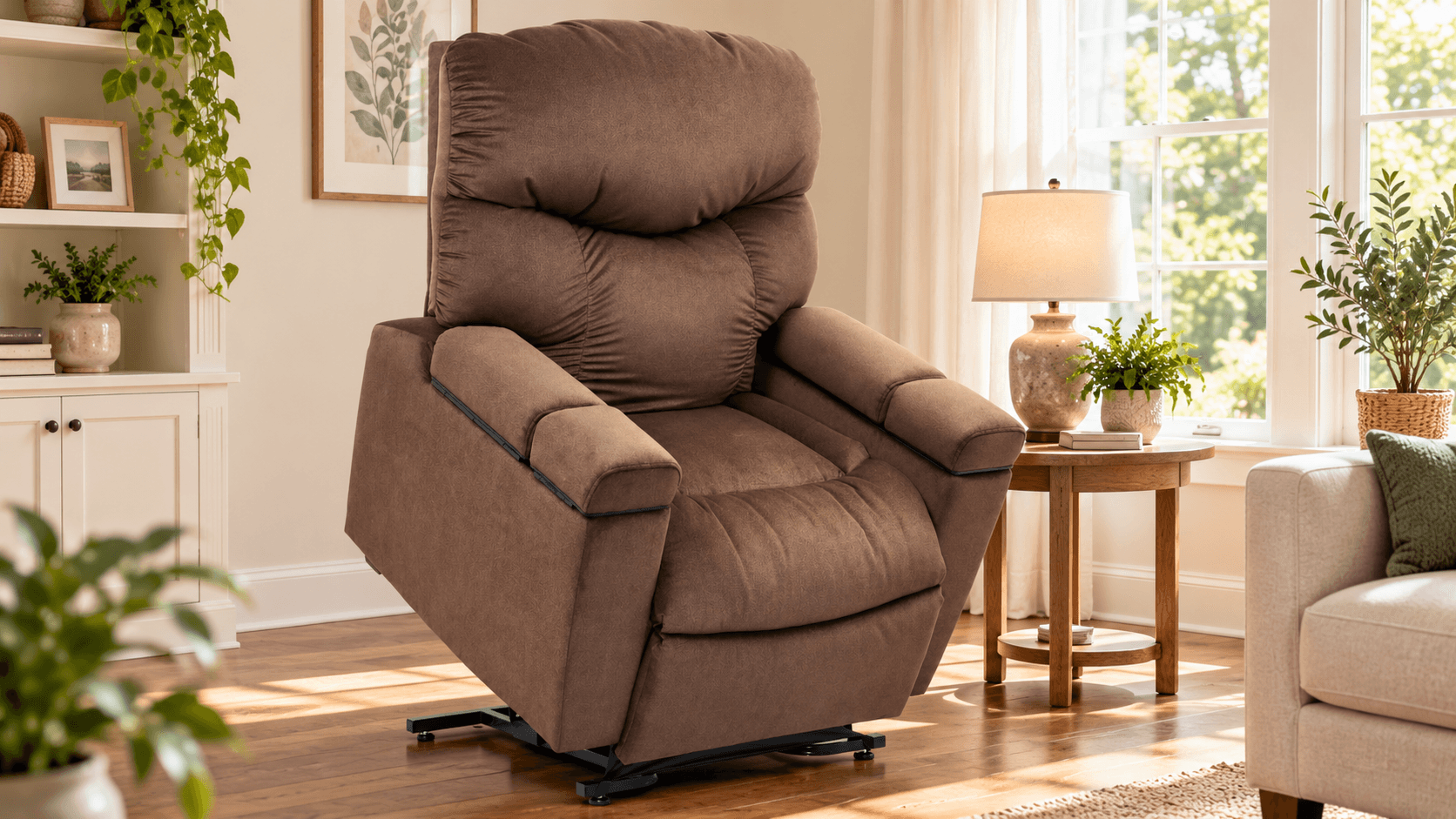
Lift Chair Positions Explained: Which Features Will You Actually Use?
Maybe you want to read with your feet up, watch television without leaning too far back, or have helprising from your favorite seat. Those are different jobs, even when two lift chairs look much alike.
The position names help narrow the choices. What matters most is whether the chair moves the way you want it to.
Start here: Do you want a simple recline, or separate control of your back and footrest?
2-position and 3-position: everyday reclining
Pride uses 2-position for a TV or reading recline and 3-position for a fuller recline. These names do not mean you must choose between only two or three fixed stops; its chairs can stop between those positions.
If you mainly want to sit upright or lean back for television, this may cover your routine. Check the exact chair's range and controls, because terminology varies.
Infinite positioning: feet up, back where you want
Want your legs supported while staying more upright to read or talk? Look for independent backrest and footrest movement. Pride's true-infinite models provide that separate adjustment; Golden also offers independently adjustable comfort zones.
Try raising the footrest, then changing only the back angle. That simple demonstration can tell you more than a long list of position names.
Extra adjustments: useful when you notice the difference
Some chairs add powered headrest and lumbar adjustments. Golden's four-zone models, for example, let you adjust those areas separately from the back and footrest.
Compare how each adjustment feels while doing something familiar, such as reading. Named positions such as zero gravity also vary by model; ask to try the actual movement.
The controls and fit deserve a turn, too
Try the remote yourself, including returning upright and using the lift function with guidance. Check whether the buttons are easy to identify and reach.
A chair can have every adjustment you want and still be the wrong size. Compare seated fit and the space it needs when reclined.
Before you choose
- Name the activities you'll use it for.
- Try your preferred positions and the remote.
- Confirm seat fit, weight capacity and room clearance.
The Takeaway
The most useful feature is the adjustment you will use regularly. Start with your routine, then compare the chairs that support it.
Explore Mobility Plus Buford's lift chairs, then call (770) 800-6681 to confirm available models. Tell us how you like to sit and what feels awkward in your current chair, so we can help you compare the right features.
10/09/2026

Wheelchair vs. Transport Chair: Which One Do You Really Need?
When people need a wheelchair rental, many automatically ask for a standard wheelchair. But if the chair is mainly for appointments, shopping, travel, or short outings, a transport chair may be a lighter and easier option - especially when a caregiver or family member will be doing the pushing.
The first question to ask is simple: Will the person need to move the chair independently, or will someoneelse be pushing them?
Standard Wheelchairs
- Larger rear wheels can allow the user to self-propel
- Better when independence is important
- Useful for more frequent or longer daily use
Transport Chair
- Smaller wheels; designed to be pushed by a caregiver or companion
- Often lighter, more compact, and easier to fold and load
- Especially practical for appointments, errands, travel, and shorter outings
Standard Wheelchair: Better for More Independence
A standard manual wheelchair typically has large rear wheels with hand rims, allowing many users to push and maneuver the chair themselves. It may be the better fit when the user needs more independence, will use the chair frequently, or may not always have someone available to push.
The tradeoff is portability. Standard wheelchairs are often larger and heavier, so folding, lifting, and loading one into a vehicle may require more effort.
Transport Chair: Lighter & Easier for Users and Caregivers
A transport chair is designed primarily to be pushed by a caregiver, family member, or companion. Because it does not need the same large rear wheels as a standard wheelchair, it is commonly lighter, more compact, and easier to fold and load into a vehicle.
That can be a major benefit for caregivers. A lighter chair can mean less lifting and handling when getting in and out of the car, while the smaller overall size can make appointments, restaurants, stores, airports, and family outings easier to manage.
A transport chair can be especially convenient for: Doctor appointments • Shopping • Restaurants • Airports • Vacations • Family outings • Short-term recovery
The Biggest Difference: Who Will Push?
Need to self-propel? → Consider a Standard Wheelchair
Caregiver or companion will push? → Consider a Transport Chair
Then consider the user's size and weight, comfort, how long they will sit in the chair, where it will be used, and how often it needs to be folded and loaded into a vehicle.
Before You Rent, Explain How You'll Use It
At Mobility Plus Buford, when someone asks for a wheelchair rental, we like to first understand where they're going, how long they'll use it, whether the user needs to propel themselves, and who will be handling the chair.
Sometimes a standard wheelchair is the right answer. Other times, customers discover that a lighter transport chair is actually more practical for their trip - and easier for the caregiver who has to fold, lift, load, unload, and push it throughout the day.
The Bottom Line
Don't choose simply because it's called a “wheelchair.” Choose based on who will push it, where you'll use it, how often you'll transport it, and how much independence the user needs.
The right chair can make the outing easier for both the user and the caregiver
09/30/2026
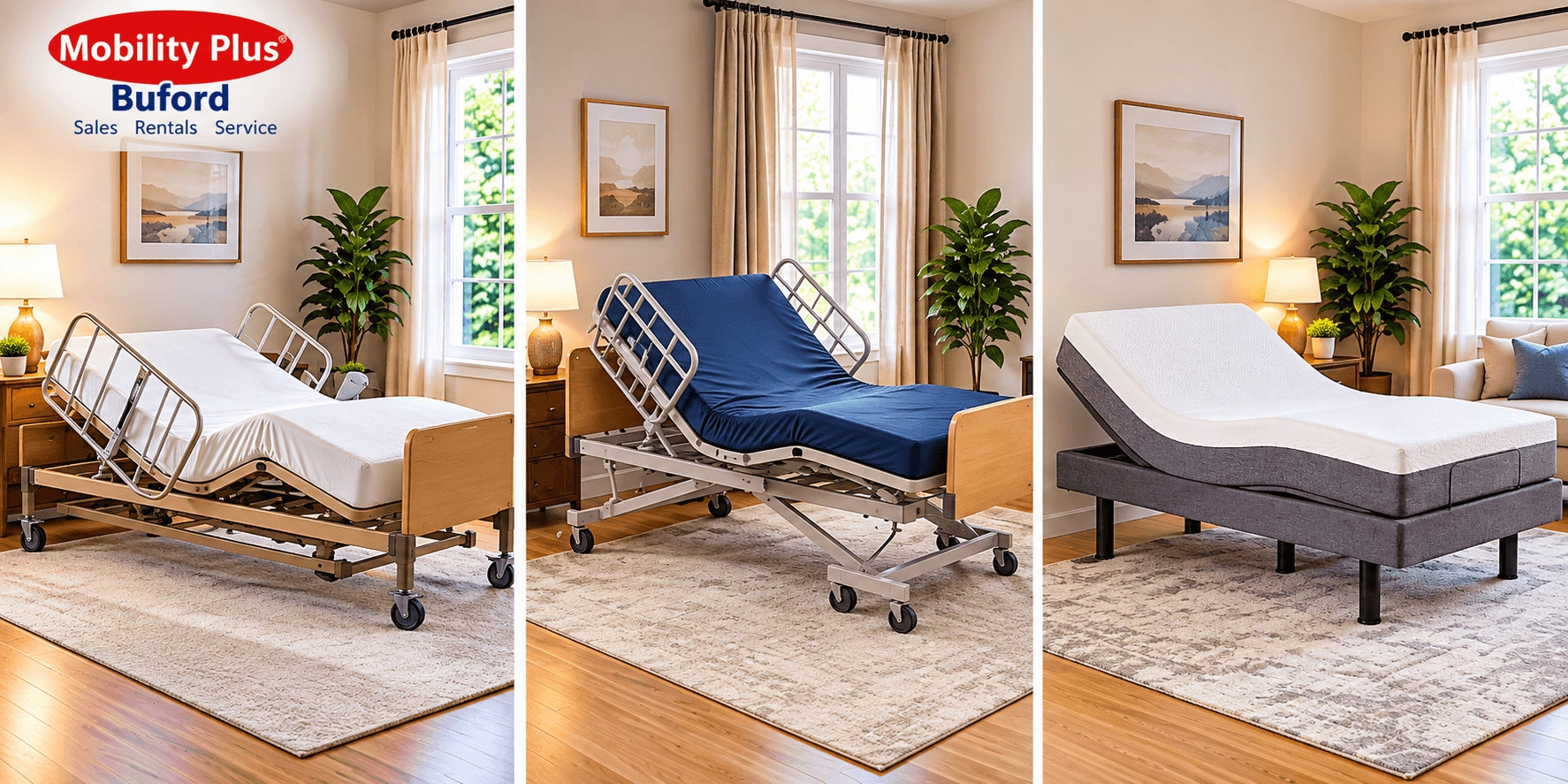
Hospital Bed, Long-Term Care Bed, or Adjustable Bed: Which Is Right for Home?
When someone needs a bed after surgery, during recovery, or for ongoing care at home, the first thought is often, "I need a hospital bed." But a traditional home care hospital bed is not the only option. Depending on mobility, caregiver needs, length of use, and desired comfort, a home care bed, long-term care bed, or adjustable bed may be a better fit.
Start with one question: What kind of care and assistance will the person need while using the bed?
1. Home Care Hospital Bed: Practical for Recovery & Home Care
A home care hospital bed is designed to make basic positioning and caregiving easier in the home. Depending on the model, powered adjustments can raise or lower the head and leg sections, and some beds also provide powered overall bed-height adjustment.
Consider it for: recovery after surgery, temporary home care, limited mobility, transfers, caregiver assistance, and short- or medium-term needs. Side rails and other accessories may also be available depending on the bed and the user's needs. For temporary situations, rental can be a practical alternative to purchasing.
2. Long-Term Care Bed: Designed for Extended Daily Care
When someone will spend significant time in bed or requires ongoing assistance, a long-term care bed may offer features beyond a basic home care bed. Depending on the model, a greater range of positioning and height adjustment can make everyday caregiving, transfers, and repositioning more manageable.
Consider it for: long-term home care, aging in place, frequent caregiver assistance, limited mobility, and extended daily bed use. Bed height can be especially important when caregivers frequently assist with personal care or transfers.
3. Adjustable Bed: Comfort With a More Residential Look
An adjustable bed is different from a medical-style home care bed. It typically allows the user to electrically raise the head and feet for sleeping, reading, watching television, or relaxing while maintaining a more traditional bedroom appearance.
Consider it for: comfort, independent positioning, everyday sleeping, and long-term bedroom use. Someone needing substantial caregiver assistance, medical-style rails, easier transfers, or overall bed-height adjustment may need features beyond a standard adjustable bed.
The Biggest Difference: Care vs. Comfort
Home Care Hospital Bed -> Recovery & everyday home caregiving
Long-Term Care Bed -> Extended care & greater caregiving needs
Adjustable Bed -> Comfort & independent positioning
Before Choosing a Bed
Consider how long the bed will be needed, whether the user can get in and out independently, how much caregiver assistance is required, whether overall bed-height adjustment is important, whether rails or other accessories are needed, and how much time the person will spend in bed each day. Mattress selection also matters, particularly for someone spending extended periods in bed.
The Bottom Line
Do not automatically choose a hospital bed simply because someone needs a powered bed at home. At Mobility Plus Buford, we recommend looking at the person's overall care situation first, then choosing the bed that provides the appropriate combination of positioning, accessibility, caregiver convenience, and comfort.
The right bed should make everyday life easier for both the person using it and the family members or caregivers helping them.
09/29/2026
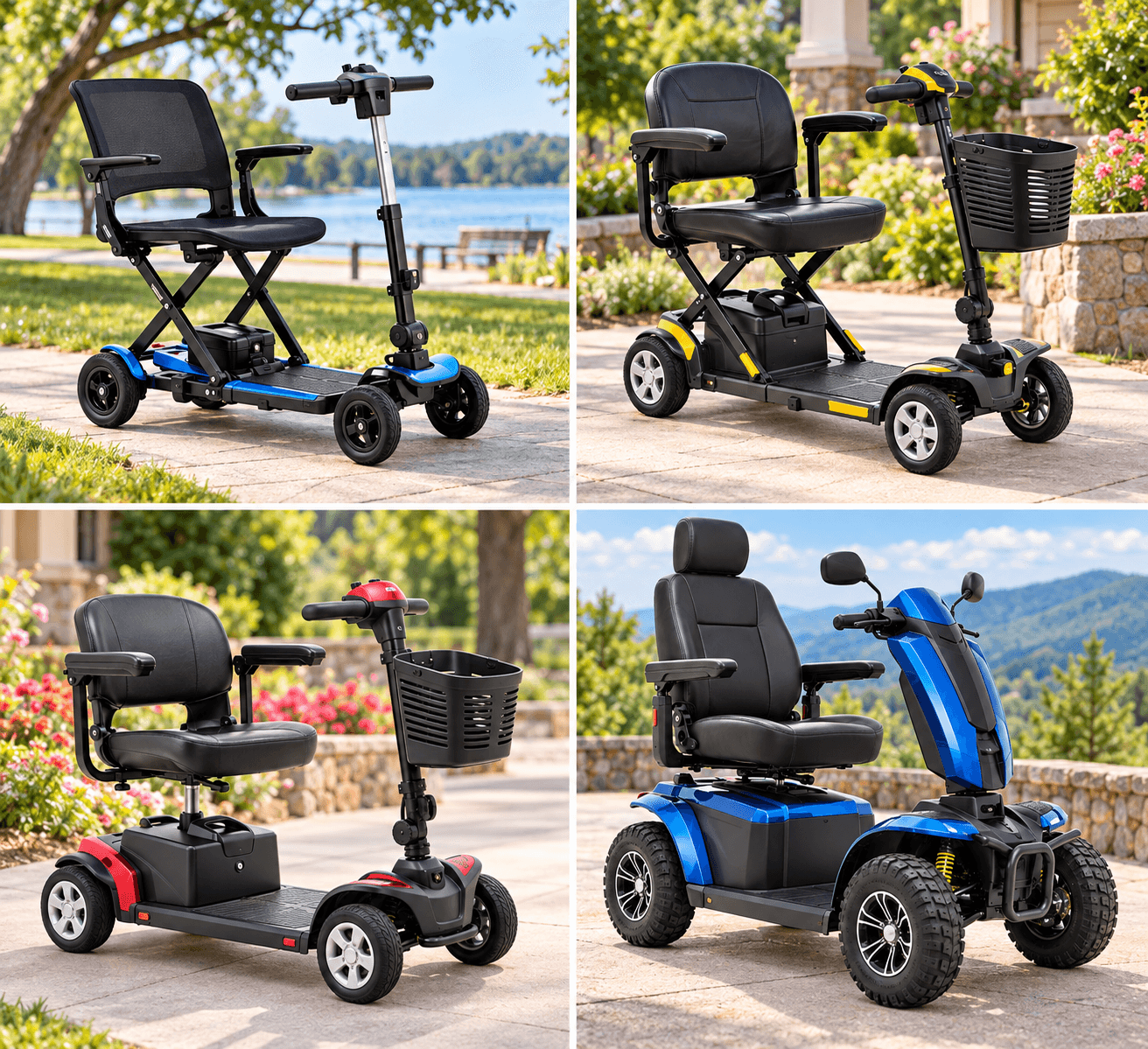
What to Consider Before Buying a Mobility Scooter: 6 Things to Know
Buying a mobility scooter isn't simply about choosing a 3-wheel or 4-wheel model, comparing speeds, or finding the longest battery range. The most important question to start with is: When and where are you planning to use your scooter?
At Mobility Plus Buford, this is one of the first things we discuss with customers. Once we understand how the scooter will be used, it's much easier to narrow down the right type based on portability, size, weight, comfort, terrain, and capacity.
1. Portability - Will You Travel With It?
If you plan to regularly put the scooter into a car, SUV, or van, portability may be one of your biggest considerations. Look for easy folding or disassembly, compact storage, and manageable component weights. Before buying, don't look only at total scooter weight. Check the weight of the heaviest piece and make sure the person loading it can comfortably handle it.
2. Narrow & Maneuverable - Will You Use It Indoors?
For restaurants, stores, senior living communities, hallways, elevators, and other tighter spaces, overall width and turning radius become especially important. A compact scooter can make everyday maneuvering easier, especially around narrow doorways, tables, displays, and crowded areas.
3. Lightweight - Will Someone Need to Lift It?
Portable doesn't always mean lightweight. If the scooter will frequently be lifted into a vehicle, ask who will actually be lifting it. For some customers, reducing the weight of the largest component is more important than speed, range, or extra features.
4. Comfort - Will You Spend a Lot of Time on It?
For longer outings and frequent daily use, comfort may become more important than minimum weight. Consider seat size, legroom, suspension, armrests, tiller position, and ride quality. A compact travel scooter may be convenient to transport, but a larger scooter may provide a more comfortable ride for extended use.
5. All-Terrain - Where Will You Drive?
If you plan to use the scooter around the neighborhood, parks, outdoor events, grass, uneven pavement, or hills, look beyond portability. Consider ground clearance, larger tires, suspension, stability, battery range, and motor performance. A scooter designed for shopping trips may not be intended for the same conditions as an outdoor-focused model.
6. Heavy-Duty - Do You Need More Capacity and Stability?
Heavy-duty scooters are designed for users who need greater weight capacity, more room, stronger construction, or a larger and more substantial platform. The tradeoff is that they are generally larger and heavier, so transportation, storage, ramps, and vehicle-lift requirements should be considered before purchasing.
Don't Start With the Scooter - Start With Your Lifestyle
There isn't one mobility scooter that's best for everyone. A frequent traveler may prioritize portability and light weight. Someone navigating restaurants and stores may prioritize a narrow design and maneuverability. Someone riding around the neighborhood may care more about comfort and range, while regular use on grass, hills, or uneven surfaces may point toward an all-terrain or heavy-duty scooter.
At Mobility Plus Buford, we help customers compare different scooter styles based on how they actually plan to use them, rather than simply choosing from a specification sheet.
The Bottom Line
Before asking, "Which scooter should I buy?", start with: "What do I want to do with my scooter?" Once that question is answered, choosing between portable, narrow, lightweight, comfortable, all-terrain, and heavy-duty options becomes much easier.
Whenever possible, test drive several scooters side by side before making your decision
09/24/2026
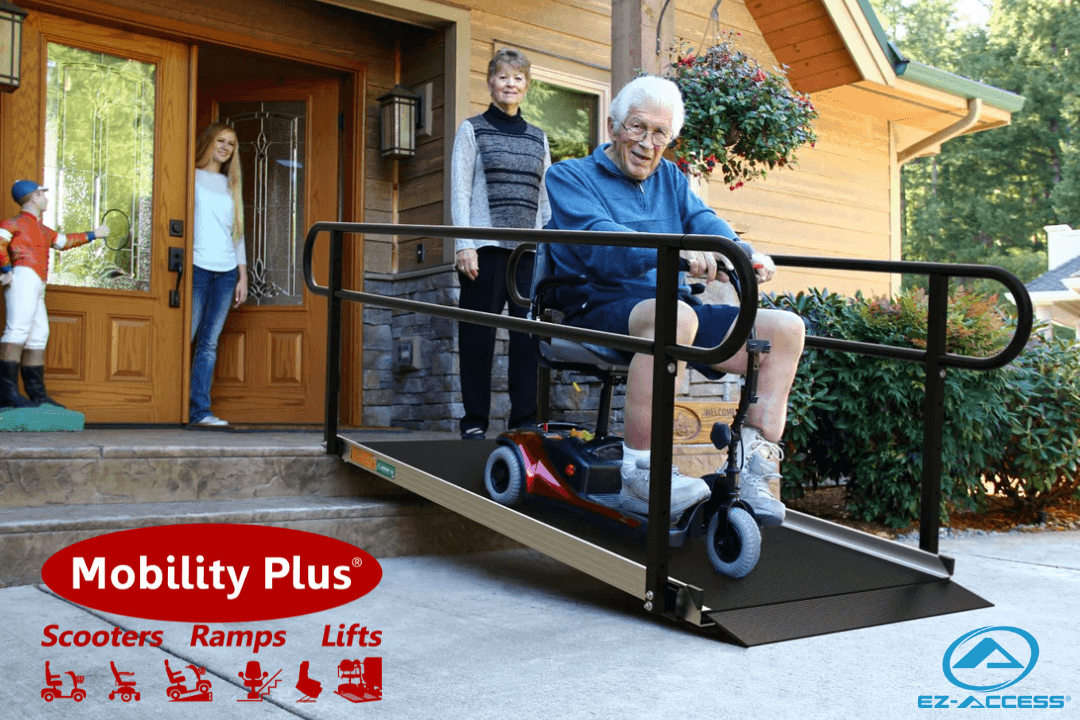
Which Entrance Ramp Is Right for Your Home? 4 Ramp Types Explained
A front step, raised doorway, garage entrance, or elevated porch can quickly become a barrier for someone using a wheelchair, mobility scooter, walker, or other mobility aid. The right ramp depends on the vertical rise, available space, mobility device, and whether the access solution is temporary or long-term.
1. Small Doorway or Threshold? Consider a Threshold Ramp
Threshold ramps are designed for small height changes at doorways, garage entrances, patios, and sliding doors. They create a smoother transition over raised thresholds without requiring a long ramp system.
Best for: small doorway rises, single thresholds, walkers, wheelchairs, and mobility scooters.
2. One or Two Steps? Consider a Folding Ramp
Folding ramps are useful when access is needed at lower steps and the ramp may need to be moved, folded, stored, or transported. They can be a practical option for temporary or occasional use.
Best for: short-term recovery, occasional access, visiting family, rental homes, travel, and lower entry steps.
3. Need a Sturdier Temporary Solution? Portable Solid Ramp
A portable solid ramp provides a continuous, stable rolling surface while still allowing the ramp to be repositioned when needed. Some configurations can also include handrails for additional support.
Best for: regular home access where a sturdy ramp is preferred but a full permanent or modular system may not be necessary.
4. Multiple Steps or a High Porch? Consider a Modular Ramp
For higher entrances, porches, decks, or daily wheelchair and scooter access, a modular ramp system can be configured with ramp sections, platforms, turns, and handrails. Modular layouts are especially helpful when a straight ramp would require too much space.
Best for: multiple steps, elevated entrances, daily mobility-device use, longer ramp runs, and aging-in-place access.
Before Choosing a Ramp, Measure These 3 Things
- Total vertical rise - measure from the lower surface to the entrance landing.
- Available ramp space - account for sidewalks, landscaping, driveways, walls, and other obstructions.
- Doorway and landing area - check door swing, turning space, and room to safely enter or exit.
Also consider the mobility device, combined user and equipment load, surface conditions, frequency of use, and whether a caregiver will assist.
Which Ramp Type Fits the Situation?
Threshold ramp: small doorway rises and transitions.
Folding ramp: lower steps, temporary access, and portability.
Portable solid ramp: a sturdier surface for regular use without a full modular system.
Modular ramp: higher rises, multiple steps, daily access, platforms, turns, and handrails.
Working with a local mobility store, such as Mobility Plus Buford, can help determine an appropriate ramp type and configuration based on the entrance, available space, and mobility equipment being used.
The Bottom Line
There is no single entrance ramp that is right for every home. A small threshold may need only a threshold ramp, while one or two steps may be better suited to a folding or portable solid ramp. A larger porch or multi-step entrance may call for a modular ramp system.
The best place to start isn't choosing a ramp - it's measuring the entrance
09/23/2026

Room-by-Room Fall Prevention: A Practical Home Checklist
The path from the sofa to the kitchen may feel familiar. Try looking at it with fresh eyes: a charging cord, a rug corner, a dark hallway. Small details can make an ordinary trip through the house harder than it needs to be.
Start with your everyday route
Check the spaces you use most, improve lighting and remove obstacles first. Then consider equipment that fits the person, the task and the room. Buying more equipment is not always the first answer.
A quick check, one room at a time
Bedroom
Look For: A dark route to the bathroom; items beside the bed.
First Step: Keep the route clear and a light within reach.
Living Room & Hallway
Look For: Loose rugs, cables and tight paths around furniture.
First Step: Remove trip hazards and allow room for the usual walking aid.
Kitchen
Look For: Everyday items stored too high; spills underfoot.
First Step: Move frequently used items within easy reach. Clean spills promptly.
Bathroom
Look For: Wet surfaces and a lack of suitable support.
First Step: Review non-slip surfaces and properly installed grab bars.
Stairs
Look For: Clutter, loose handrails or poorly lit steps.
First Step: Keep steps clear; arrange repairs and lighting where needed.
The CDC home safety checklist is a useful companion for this walk-through. Ask someone to help.
Choose the solution after you name the problem
“Getting through the bathroom doorway is difficult” is more useful than “we need something safer.” Write down where movement becomes awkward, what support is already used and whether the problem changes at night. Take room measurements or photos if helpful.
A bath seat, transfer bench and grab bar serve different purposes. The right arrangement depends on the bathroom layout and how the person moves. Follow manufacturer instructions and get appropriate installation and professional advice; do not treat a towel bar as support equipment.
At Mobility Plus Buford, our mobility equipment selection includes bath seats, benches, grab bars, walkers and rollators. Bring your room measurements and questions, and call ahead about the options available to compare. A product category alone cannot tell you what will fit your home.
Quick answers
What should I change first?
Start with the route you use most. Clearing an obstruction or improving lighting may be a more useful first step than buying a device.
Can equipment prevent every fall?
No. Home hazards are only part of the picture. Balance, vision and medicines can also matter. The CDC recommends discussing fall risk with a healthcare professional; ask for individual guidance if you feel unsteady or have fallen.
What should I bring to the store?
Bring measurements, photos of the problem area and the model of any equipment you already use. Include relevant recommendations from your clinician or therapist. inspect or move things; do not climb or reach awkwardly just to complete a checklist
09/16/2026

5 Fall-Risk Spots to Check Before Your Next Outing
A short outing starts before you reach the car. There is the doorway to get through, the path outside, the parking area and the entrance at the other end. Planning those transitions can be just as important as choosing a destination.
Think about the whole trip
Look for a clear, usable route, plan rest stops and allow time. A walker or rollator should suit both the person using it and the places they need to go. No walking aid makes every surface suitable.
Five Places Worth a Closer Look
Doorway
Look For: A raised threshold, loose mat or door that crowds the path.
Plan Before Moving: Clear the area and arrange help with the door if needed.
Porch or Steps
Look For: Loose rails, poor lighting or objects on the steps.
Plan Before Moving: Address hazards; use a suitable alternative route if needed.
Outdoor Walkway
Look For: Broken pavement, wet leaves or uneven surfaces.
Plan Before Moving: Choose a clear route instead of a difficult shortcut.
Parking Area
Look For: A slope, curb or too little room beside the vehicle.
Plan Before Moving: Choose a suitable space and plan the route to the entrance.
Destination Entrance
Look For: Steps, heavy doors or no nearby seating.
Plan Before Moving: Ask about accessible access and places to rest before visiting.
For errands around Buford or a visit farther into Northeast Georgia, check the actual entrance rather than assuming every building has the same access. Ask where to arrive, how far the entrance is and whether the route includes steps.
A rollator seat is for a stopped rest break
Many rollators have a seat, but an ordinary rollator is not a wheelchair. NOVA advises stationary sitting only, with the parking brakes locked; do not sit and scoot or have someone push you. Follow the exact model’s instructions and choose a suitable level place to rest. Read NOVA’s walker and rollator guide.
Before selecting equipment, ask for a demonstration of the brakes, folding mechanism and adjustments. Explain what you need to do outside, not just which color or style you prefer. If the brakes or controls are difficult to operate, discuss another option rather than working around the problem.
Quick answers
Will larger wheels make every outdoor route safe?
No. Surface conditions and the exact product’s limits still matter. Discuss the routes you actually use and follow the manufacturer’s instructions.
Should I buy a cane, walker or rollator?
Do not choose from appearance alone. The support needed, ability to operate controls and intended route all matter. Ask your clinician or therapist which type is appropriate, then compare suitable models.
What if I am newly unsteady or afraid of falling?
A new device is not a substitute for an assessment. Discuss the change with your healthcare professional before pushing through a difficult outing. The CDC’s fall-prevention guidance explains why personal risk factors also need attention.
09/15/2026
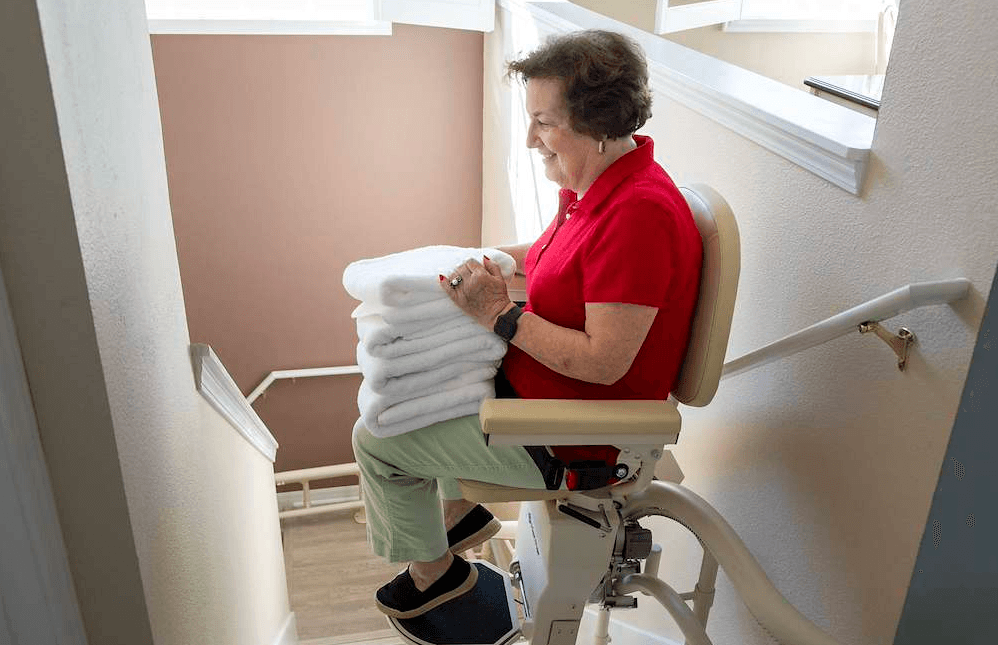
Will a Stair Lift Fit My Home? What to Check Before Getting a Quote
Often, yes. The right fit depends on the staircase, clear space at both ends, and the person using the lift. A photo can start the conversation; an in-home assessment confirms the installation plan.
If the stairs are making part of your home harder to reach, start with the layout you already have. Before comparing stair lift prices, check these three things.
1. Follow the entire staircase
Is it one straight flight, or does it turn? Include intermediate landings and any change in direction. Straight and curved staircases need different rail planning; do not assume two straight lifts are the best answer for a turning staircase.
2. Look beyond the wall-to-wall width
Handrails, trim and other projections can reduce usable space. The assessor also needs to consider the rider's knees and feet and room for others to walk past. There is no single minimum width that guarantees every model will fit.
3. Check where you get on and off
Open nearby doors and look at the top and bottom landings. The seat needs a suitable place for the rider to transfer, and the rail must not create an obstruction. A folding rail may be an option where space is tight, depending on the model.
What to have ready for your quote
Bring or Discuss Photos from Both Ends: This helps to show the full flight, turns, and nearby doorways
Bring or Discuss Basic Measurements: This helps to note clear width and landing space. Leave final installation measurements to the assessor.
Bring or Discuss the Rider's Needs: This helps to discuss seat fit, controls, and getting on and off the lift.
Bring or Discuss Your Intended Use: This helps to explain whether you need a purchase or temporary rental, and your timing.
At Mobility Plus Buford, our evaluation and installation service gives North Georgia homeowners a way to work through these questions before choosing equipment. Start with the staircase and the rider, then compare the available options.
Quick answers
Will the rail attach to my wall?
Many stair lifts, including Bruno models, mount to the stair treads. The installer must confirm the mounting method and stair condition for the selected system.
Can I get an exact price from a photo?
Photos help with an initial discussion. Stair shape, rail requirements and options still need assessment before the final quote.
Can I rent a stair lift?
We offer stair lift rentals. Ask which options are suitable for your staircase and what installation, removal and rental terms apply.
09/11/2026
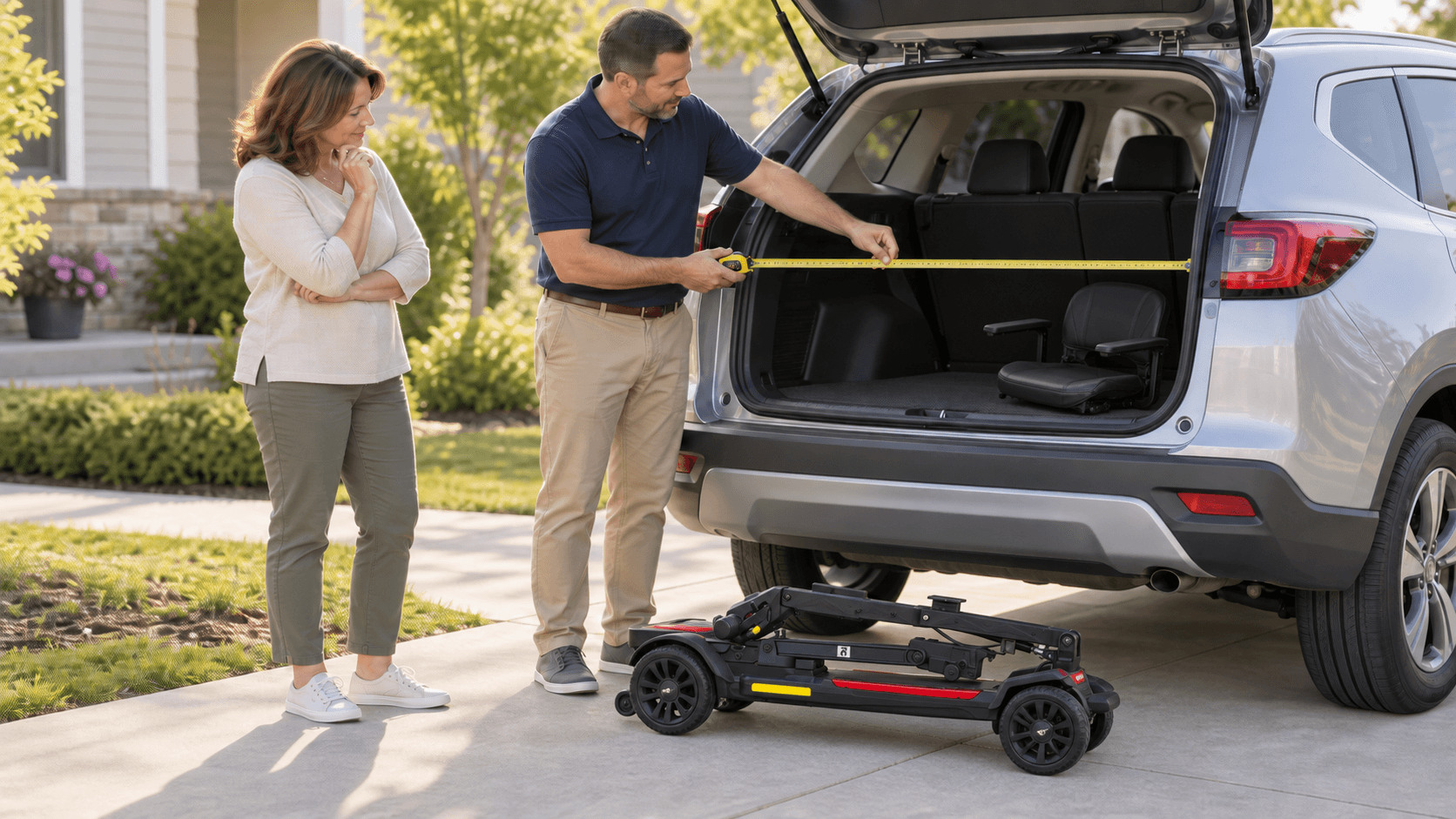
Will a Folding Mobility Scooter Fit in My Car?
It may - but folding is only the first check. The scooter must pass through the opening, fit inside with the hatch or trunk closed, and be manageable for the person loading it.
A scooter can look compact online and still be awkward to load. Before buying a folding mobility scooter for car travel, compare the actual loading setup with the vehicle you use every day.
1. Measure the opening first
Check the narrowest usable width and height of the trunk or hatch opening. A roomy cargo area does not guarantee the scooter can pass through the entry. Curved edges and a raised trunk lip can make the angle harder.
2. Compare the folded setup, not the riding size
Use the manufacturer's folded length, width and height for the exact model. Check whether that figure excludes the seat or battery. Leave space for removed parts, shopping bags and the seats you need to keep upright.
3. Check what you actually have to lift
Look for the heaviest-piece weight, not just the total weight. Ask what must be removed to reach that figure. A lift from the floor is different from lifting over a car sill; do not attempt a load that feels unmanageable
Which loading setup suits your routine?
Folding Scooter Setup
Check before choosing: Folded size, remaining lifting weight and any separately stored components
Disassembling Scooter Setup
Check before choosing: Heaviest section, number of pieces and how easily you can reassemble it.
Scooter with a Vehicle Lift Setup
Check before choosing: Compatibility among the exact scooter, vehicle and lift; professional assessment is needed
Hands-on practice matters. In a review on our Buford service page, a customer described repeated demonstrations of taking a scooter apart and putting it back together. That was not a car-fit test, but it highlights a useful question: can you repeat the loading routine yourself?
Quick answers
Does “folding” mean I can lift it alone?
No. Folding describes how it stores. Weight, grip points, reach and your loading height still matter.
Will it fit in a sedan?
Possibly. Compare the exact scooter setup with your trunk opening and usable space; the vehicle category alone is not enough.
What if it fits but is too heavy?
Ask about a different breakdown design or a compatible vehicle lift. Follow the equipment and vehicle instructions for securing it during travel.
09/09/2026
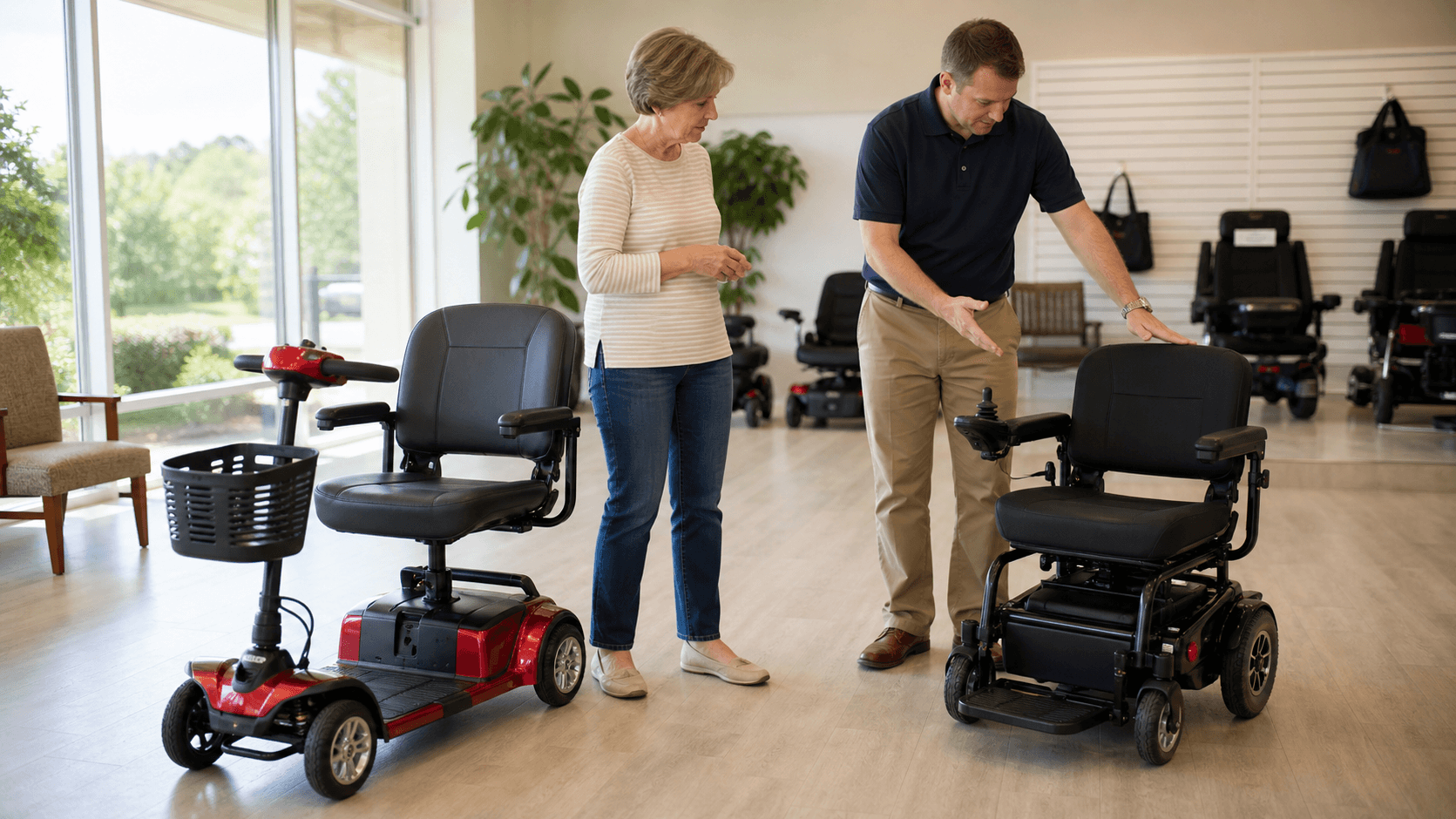
Mobility Scooter or Power Chair? How to Choose the Right Fit for Daily Life
A mobility scooter and a power chair can both make daily life easier, but they are not interchangeable. The difference becomes clear when you picture a normal day: moving through the kitchen, turning in a hallway, getting close to a table, loading the device into a vehicle, or spending an afternoon outdoors. The right choice is the one that fits the rider's body, the home, the transportation plan, and the places the device will actually go.
The simplest difference: tiller steering or joystick control
Most mobility scooters use a tiller, so the rider steers with both hands in front of the body. This works well for many people who can sit upright, reach forward comfortably, turn the tiller, and transfer on and off the seat.
A power chair uses a joystick, usually mounted near one armrest. It can require less upper-body movement and often allows the chair to turn in a smaller space. That can matter in bedrooms, kitchens, narrow hallways, or crowded restaurants.
Neither control style is automatically better. The question is which one the rider can use comfortably and consistently throughout the day.
When a mobility scooter may be the better fit
A scooter often makes sense for someone who walks short distances but wants help for shopping, community events, travel, or longer outdoor routes. Many riders like the familiar handlebars, swivel seat, basket, and open feel.
Scooters come in travel, mid-size, full-size, and heavy-duty designs. A compact model may be easier to load, while a larger scooter may offer different seating, battery, or outdoor features. Turning radius and overall length can make scooters harder to position beside a table or inside a small bathroom.
The red Golden Technologies Buzzaround CarryOn GB120 shown with this article is one example of a portable four-wheel scooter. Golden's current specifications list a 300-pound capacity, a 47.5-pound heaviest piece without the
seat and batteries, and a fold-flat height of 12 inches without the seat. Those numbers are useful only after confirming the rider's fit and the vehicle's cargo opening.
When a power chair may be the better fit
A power chair can be a strong choice when the device will be used frequently inside the home, when close positioning matters, or when tiller steering is uncomfortable. Joystick control and a compact turning pattern can make it easier to approach a desk, table, sink, or bedside.
Power chairs range from lightweight folding models to more supportive mid-size and full-size designs. Portability, seat comfort, turning radius, ground clearance, and control placement vary widely. A chair that turns beautifully indoors may not be the right match for rough outdoor surfaces, and a larger outdoor chair may be difficult to transport.
Five questions that usually settle the decision
- Where will it be used most? List the rooms, sidewalks, stores, parking lots, ramps, and outdoor surfaces that are part of a normal week.
- How will the rider transfer? Try the seat height, armrests, foot area, and any swivel or swing-away features.
- How will it travel? Measure the vehicle opening, cargo height, narrowest width, and the weight of the heaviest piece the household can safely handle.
- How tight are the spaces at home? Measure doorways and test real turns near furniture, not only an open showroom aisle.
- How long will the rider sit? Compare seat width, depth, back support, armrest position, and access to the controls.
Do not choose by range or price alone
Published range is a planning estimate, not a promise for every trip. Rider weight, slopes, temperature, speed, battery condition, and surface resistance can all change real-world distance. The lightest device is not always the easiest to load, and the least expensive option is not a bargain if it does not fit the home.
Also think ahead. If the device will later need a vehicle lift, the combined weight, dimensions, hitch rating, and vehicle capacity must be checked together. Mobility Plus Buford's vehicle-lift guide is a useful next read when transportation is part of the decision.
Why a test drive matters
A comparison makes more sense after driving both types. With a scooter, test the tiller reach, seat swivel, turning circle, and the way your feet rest on the deck. With a power chair, test joystick sensitivity, stopping, backing up, doorway alignment, and how closely the chair can approach a table.
Use the same route for each device. Start, stop, make a tight turn, back into a marked space, and practice approaching a doorway. If the device needs to be transported, go through the actual folding or disassembly steps and identify the heaviest part before deciding.
Try both at Mobility Plus Buford
Mobility Plus Buford carries mobility scooters and power chairs in compact, travel, and larger configurations. The showroom allows customers to try different models, compare controls, and ask about setup, training, batteries, transportation, and service.
Bring the rider whenever possible, along with doorway and vehicle measurements and a short list of typical destinations. Visit 1620 Buford Hwy, Ste 106, Buford, GA 30518, serving customers from Buford, Sugar Hill, Suwanee, Flowery Branch, Braselton, and the surrounding North Georgia area.
Frequently Asked Questions
Is a mobility scooter easier to transport than a power chair?
Sometimes, but not always. Compare folded or disassembled dimensions, the heaviest piece, the number of steps required, and the vehicle opening for the exact models.
Which turns more tightly: a scooter or a power chair?
Many power chairs have a tighter turning pattern because they use joystick control and a compact drive base. Exact turning radius varies by model, so test the device in a space similar to the home.
Can a mobility scooter be used inside the house?
Yes, if the model fits the doorways, turning spaces, floors, and daily route. Longer scooters can be difficult in compact rooms, so measure and test before choosing.
Is the Golden GB120 a heavy-duty scooter?
No. Golden identifies the GB120 as the Buzzaround CarryOn travel scooter. The CarryOn HD is model GB220. Confirm the exact model and specifications before purchasing.
Can I test a scooter and power chair near Buford?
Yes. Mobility Plus Buford offers in-showroom product comparisons. Call (770) 800-6681 to confirm current models and plan a visit.
09/03/2026

Shower Chair, Transfer Bench, or Grab Bars? A Bathroom Safety Guide for North Georgia Homes
Bathroom safety questions often start the same way: "Do we need a shower chair, a transfer bench, or grab bars?" The honest answer is that these products solve different parts of the routine. A shower chair helps someone sit while bathing. A transfer bench is designed to make crossing a bathtub wall easier. Grab bars provide a fixed handhold at the places where balance is most likely to change. For many North Georgia homes, the best setup is a thoughtful combination rather than one product chosen in a hurry.
Start with the bathroom routine, not the product
Before shopping, walk through the routine from beginning to end. Is the hardest moment stepping over the tub wall, turning inside the shower, lowering onto a seat, standing back up, or reaching the toilet? The location of the difficulty usually points toward the right solution.
It also helps to notice what the person already uses for support. A towel bar, shower door, sink edge, or loose counter is not designed to carry body weight. If someone is reaching for one of those surfaces, that is a clear sign the room needs a safer plan.
When a shower chair makes sense
A shower chair sits fully inside a walk-in shower or bathtub. It can be a good fit for someone who can enter the bathing area but becomes tired or unsteady while standing. Common features include adjustable legs, non-slip feet, a backrest, armrests, and drainage holes.
Check the shower floor before choosing one. The chair must sit level with all four feet supported. Measure the available floor space, the distance between doors or curtains, and the user's preferred seat height. If the person still has to make an unsafe step over a high tub wall, a shower chair alone may not solve the main problem.
When a transfer bench may be the better choice
A transfer bench extends over the side of a bathtub. The user sits on the outside portion, then moves across the bench so both legs can be brought into the tub without standing on one foot. This can reduce the need to step over the tub wall.
Transfer benches need more room than shower chairs. Measure the tub wall, the inside width of the bathtub, the floor space outside the tub, and the location of the toilet or vanity. Door swing and shower-curtain placement matter too. A bench that fits the tub but blocks the doorway is not a workable solution.
Some people transfer independently; others need help. If transfers are already difficult, ask an occupational or physical therapist to review the movement before changing the setup.
What grab bars add
Grab bars provide a fixed place to steady the body during entry, exit, turning, sitting, or standing. They may be useful near the shower entrance, along the bathing wall, or beside the toilet. Placement matters more than simply adding more bars.
A professionally installed bar should be matched to the wall structure and the user's reach. A towel bar is not a grab bar, and a suction-mounted handle should not be treated as a permanent weight-bearing support. Before installation, practice the movement and note exactly where the person's hand naturally reaches.
Why many bathrooms use more than one solution
Think of the bathroom as a short route with several separate tasks. A transfer bench may address the tub wall, a grab bar may help with the turn and repositioning, and a hand-held shower can make seated bathing easier. A shower chair may work well in a walk-in shower but still need a nearby grab bar for entering and standing.
The goal is not to fill the room with equipment. It is to remove the few moments that cause the most uncertainty while keeping enough clear space for the user and any caregiver.
Measurements to bring before you shop
A few simple measurements can prevent a frustrating return trip:
- Tub or shower opening width and inside floor dimensions
- Height and width of the bathtub wall
- Clear floor space outside the bathing area
- Distance to the toilet, vanity, door, and nearby cabinets
- Door direction and the location of curtains or sliding tracks
- The user's comfortable seated height and any width needs
Photos of the full bathroom, tub edge, shower wall, and floor are helpful too. Avoid close-up photos that hide the rest of the room.
A practical way to decide
If the main concern is standing endurance, start by comparing shower chairs. If stepping over the tub wall is the difficult moment, compare transfer benches. If the person needs a stable handhold during several parts of the routine, discuss grab-bar placement. When more than one problem appears, plan the pieces together.
Mobility Plus Buford carries fall-prevention products including bath seats, bath benches, and grab bars. Bring your measurements and room photos to the showroom at 1620 Buford Hwy, Ste 106, Buford, GA 30518. The team can help you compare size and features and discuss whether a home consultation or professional installation is appropriate.
Frequently Asked Questions
Is a shower chair the same as a transfer bench?
No. A shower chair sits inside the bathing area. A transfer bench extends over the bathtub wall so the user can sit before moving into the tub.
Can grab bars be installed anywhere?
No. Placement should match the user's movement and the wall must be able to support the installation. Professional evaluation and installation are recommended when the structure is uncertain.
Are suction grab bars safe?
They may offer a visual cue or light balance reminder, but they should not be treated as permanent weight-bearing grab bars. Follow the product instructions and do not substitute them for properly anchored support.
What should I measure for a transfer bench?
Measure the tub wall, tub interior, floor space outside the tub, door swing, and clearance from the toilet and vanity. Bring photos showing the whole bathroom.
Where can I compare bathroom safety equipment near Buford?
Visit Mobility Plus Buford at 1620 Buford Hwy, Ste 106, or call (770) 800-6681 to discuss current products, measurements, and installation options.
09/01/2026

Mobility Scooter Rental in North Georgia: Cost, Delivery, and What to Know Before Reserving
People often begin a mobility scooter rental search with one question: How much will it cost? The most accurate answer depends on more than the number of days. Scooter size, rider needs, transportation, destination, delivery, and current inventory all matter. A little preparation before calling can help you get a clearer quote and avoid discovering too late that the scooter is difficult to load, too large for the destination, or missing a feature the rider needs.
What affects the cost of a mobility scooter rental?
There is no single rental price that fits every situation. The total can change with the number of rental days, the type of scooter, pickup or delivery, the destination, requested accessories, and current inventory. A compact travel scooter and a larger full-size scooter may have different rates because they serve different needs. When requesting a quote, give the exact start and return dates and ask whether delivery, setup, pickup, taxes, deposits, or other charges are included. That makes it much easier to compare the complete cost instead of comparing only a daily or weekly rate.
Travel scooter or full-size scooter?
A travel scooter is designed with transport in mind. Many models separate into manageable pieces or fold, which can make them easier to load into some vehicles and use in tighter indoor spaces. A full-size scooter may offer a wider seat, more legroom, greater stability, or a longer advertised range, but it is also typically heavier and may require a lift, ramp, or larger vehicle. Neither category is automatically better. Describe the rider, vehicle, destination, expected surfaces, and how the scooter will be loaded so the store can identify an appropriate available model.
Reserve early for travel, events, and recovery
Scooter inventory can change quickly around festivals, family visits, vacations, and holiday weekends. A reservation made in advance gives you more time to confirm the model, delivery window, vehicle fit, and return plan. It also leaves room to adjust if the first option does not match the rider or destination. If the rental supports a planned surgery or hospital discharge, coordinate the dates with the care team and discharge planner, but avoid reserving equipment based only on an estimated date. Ask how date changes and extensions are handled before you commit.
Pickup or delivery: confirm the complete plan
Mobility Plus Buford offers mobility equipment rentals with pickup and drop-off options in its service area, but availability, timing, and charges should be confirmed for each reservation. Provide the full address and explain whether the destination is a home, hotel, assisted living community, venue, or medical facility. Mention stairs, elevators, gated entrances, loading restrictions, and any required delivery appointment. Ask who will receive the scooter, whether setup or instruction is included, and how pickup will be scheduled at the end of the rental.
Have rider and vehicle details ready
Before calling, note the rider's approximate height and weight, preferred seat width, ability to step on and off the scooter, and whether armrests or a swivel seat are important for transfers. Measure the vehicle's cargo opening and usable cargo space, not just the trunk floor. Ask for the scooter's assembled dimensions, folded or disassembled dimensions, total weight, and weight of the heaviest piece. A salesperson can explain the model, but the person loading it should confirm that the equipment and lifting process are realistic for the actual vehicle and caregiver.
Ask about battery range and charging
Published driving range is an estimate, not a promise for every trip. Rider weight, hills, temperature, speed, frequent stops, surface conditions, and battery condition can all affect real-world distance. Tell the store where the scooter will be used and how long it may be away from an outlet. Ask for a demonstration of the battery gauge, approved charger, charging port, key, freewheel lever, and basic shutdown procedure. Charge only as instructed for the specific model, and never plan a route that depends on reaching the maximum advertised range.
Know what is included before you leave
Confirm that the charger, key, basket, seat, armrests, and any requested accessories are included and in working order. Review the controls, speed settings, tiller adjustment, turning space, charging routine, transport steps, and what to do if the scooter stops operating. Ask for the rental agreement, damage and cleaning terms, extension policy, late-return rules, and a service contact. Take a few minutes to practice starting, stopping, turning, and parking in a clear area. A short demonstration can prevent confusion when the scooter is needed away from the store.
When buying may be more practical
Renting is often useful for a short recovery, a temporary visit, travel, or an event. Buying deserves consideration when the scooter will be used regularly, needs to be available every day, or requires specific comfort and transport features. Compare the expected rental duration and total rental cost with suitable mobility scooter purchase options, warranty coverage, and future service needs. A showroom test drive can reveal differences in seat comfort, steering, turning radius, portability, and stability that are difficult to judge from photos.
Local rental help for North Georgia
Customers in Buford, Sugar Hill, Suwanee, Flowery Branch, Braselton, North Georgia, Northeast Georgia, and the Midtown Atlanta area can call Mobility Plus Buford to discuss current rental inventory and delivery options. Start with the dates, destination, rider information, vehicle measurements, and whether pickup or delivery is preferred. Because models and availability change, call before making a special trip or promising a particular scooter to a family member. The goal is not simply to reserve any scooter; it is to reserve one that works for the person, the trip, and the transportation plan.
Frequently Asked Questions
How much does a mobility scooter rental cost near Buford?
Pricing depends on the rental length, scooter type, current inventory, pickup or delivery, destination, and requested accessories. Call with the exact dates and needs for a complete quote, and ask which charges are included.
How far in advance should I reserve a scooter?
Reserve as early as practical once the dates are reasonably certain, especially for holidays, festivals, vacations, and planned recovery periods. Inventory is not guaranteed until the store confirms the reservation and terms.
Will a rental scooter fit in my car?
It depends on the scooter and the vehicle. Compare the cargo opening and usable space with the scooter's folded or disassembled dimensions, and confirm the heaviest piece can be lifted safely by the person handling it.
Does Mobility Plus Buford deliver rental scooters?
Pickup and drop-off options may be available within the store's service area. Confirm the address, delivery window, setup, pickup plan, access details, and all related charges when requesting the quote.
Should I rent or buy a mobility scooter?
Renting often fits a short or temporary need. Buying may be more practical for frequent or ongoing use, daily availability, or specific comfort and transport features. Compare the complete rental cost, purchase price, warranty, and service needs.
08/27/2026

Going to Suwanee Fest? A Mobility Scooter & Wheelchair Rental Checklist
A festival day should feel fun, not like an endurance test
Suwanee Fest brings a full weekend of vendors, food, entertainment, family activities, and a parade to Town Center Park. The official festival site says nearly 200 vendors are expected, which means the day can involve long routes, repeated stops, lines, and more time on the move than a short visit to the park. For someone recovering from an injury, living with limited stamina, or supporting a family member with mobility needs, planning the equipment before the outing can make the difference between leaving early and enjoying the event at a comfortable pace.
1. Start with the day, not the device
Think through the full outing before choosing equipment. How long will you stay? Will the rider need to move independently or be pushed by a companion? Is the route expected to include grass, slopes, curbs, or crowded paved areas? Will the equipment travel in a car, or will delivery be needed? A short conversation about the destination, rider, vehicle, and schedule is more useful than choosing from a photo alone.
2. Decide whether renting or buying fits the need
Rental often makes sense for a single festival, short recovery period, visiting guest, or temporary travel need. Buying may be worth discussing when the user expects frequent community outings, appointments, shopping trips, or ongoing mobility support. A rental can also provide practical experience with size, transport, controls, and comfort before a longer-term purchase decision. Availability varies, so ask what models and rental periods are currently offered rather than assuming a specific chair or scooter is in stock.
3. Compare the right category
A transport chair is designed to be pushed by a companion and can be easier to load into some vehicles. A manual wheelchair may allow self-propulsion, depending on the user and setup. A mobility scooter can support independent travel but usually requires more cargo space and attention to turning room, slopes, ground clearance, and battery charging. Specialized seating or positioning needs should be discussed with an appropriate clinician or seating professional; a general rental counter cannot replace an individualized medical assessment.
4. Confirm fit and transportation before pickup
Share the rider's approximate height and weight, the needed seat width, any transfer concerns, and whether a caregiver will assist. Then measure the vehicle's cargo opening, narrowest interior point, and usable space after passengers and bags are loaded. If the equipment separates or folds, ask for the heaviest component weight and a demonstration. If lifting is not realistic, ask Mobility Plus Buford whether a different model or local delivery arrangement would be more practical.
5. Check current parking, shuttle, and event rules
Suwanee Fest directs visitors to official parking and shuttle information, and those details can change as the event approaches. Before leaving home, review SuwaneeFest.com and its parking page, then contact festival organizers with questions about accessible parking, passenger drop-off, wheelchair or scooter acceptance on shuttles, entrances, restrooms, and assistance. Mobility Plus Buford supplies mobility equipment; it does not control festival transportation or venue policies.
6. Prepare for an outdoor September event
The festival is outdoors and scheduled rain or shine. Check the forecast, identify places to rest, and prioritize the vendors or performances you most want to see. Follow the rental provider's charging instructions, bring the supplied charger only if advised, and keep paperwork and the store phone number available. Battery range varies with terrain, rider weight, stops, temperature, and equipment condition, so a published maximum should never be treated as a guaranteed festival-day distance.
7. Reserve early and practice for five minutes
Community events can create a rush for short-term mobility equipment. Call early with the event dates, pickup and return plan, rider details, destination, and vehicle information. At pickup, practice starting, stopping, turning, backing up, setting a safe speed, reading the battery indicator, and securing the device for transport. Those few minutes can make a crowded festival route feel much more manageable.
Planning Suwanee Fest or another North Georgia outing?
Mobility Plus Buford helps customers compare mobility scooter and wheelchair rental and purchase options for festivals, family visits, travel, and recovery. We serve customers from Buford, Suwanee, Sugar Hill, Flowery Branch, Braselton, Northeast Georgia, North Georgia, and the Midtown Atlanta area. Call (770) 800-6681 to ask about current availability, sizing, rental terms, pickup, or delivery. You can also visit 1620 Buford Hwy, Ste 106, Buford, GA 30518 to speak with the local team.
Frequently Asked Questions
Does Suwanee Fest provide mobility scooters or wheelchairs?
The official festival information reviewed for this guide does not promise on-site mobility equipment rentals. Contact Suwanee Fest directly for the latest services and policies. If you need a device for the weekend, reserve it independently before the event.
How early should I reserve a scooter or wheelchair for the festival?
Reserve as early as possible once your plans are firm. Weekend inventory can change, and the reservation is not complete until the provider confirms the device, dates, rental terms, pickup or delivery, and payment requirements.
Can a mobility scooter go on the Suwanee Fest shuttle?
Do not assume every shuttle can carry every scooter or wheelchair. Ask festival organizers which shuttle locations and vehicles can accommodate the specific device, and provide its dimensions and weight if requested.
What information helps choose the right rental?
Share the rider's approximate height and weight, seat-width needs, expected surfaces, length of the outing, transfer or caregiver needs, vehicle make and model, cargo measurements, and whether pickup or delivery is preferred.
Should I rent or buy a pediatric or adult wheelchair for occasional outings?
A short-term rental may fit a one-time event or recovery period, while buying may be more practical for frequent use. Pediatric sizing and specialized positioning require particular care, so confirm fit and involve a qualified clinician or seating professional when medical or postural support is needed.
08/20/2026

Coming Home After Surgery or a Hospital Stay? Your Home Safety & Mobility Checklist
A smoother homecoming starts with a few simple questions
Coming home is a milestone, but the first few hours can feel harder than expected when the entry route, furniture, or equipment has not been planned. Before discharge, follow the path from the vehicle to the place where you will rest. Count the steps, look for a steep threshold, note loose gravel or uneven pavement, and make sure the doorway opens wide enough for the recommended equipment. If a porch or garage step cannot be avoided, ask whether a portable ramp or another access option may fit the space. Always follow the care team's instructions for transfers and weight-bearing.
1. Start with the home, not the equipment
A Midtown Atlanta condo, a North Georgia home with porch steps, and a Northeast Georgia property with wider rooms can require very different solutions. Choose one comfortable living area near a bathroom, phone charger, water, medications, and frequently used items. Keep essentials within easy reach and, when possible, use the same floor for the bed and bathroom. Temporarily rearranging furniture, improving lighting, and opening a clear path can make the daily routine much easier to manage.
2. Measure - do not guess
A product can be appropriate in theory and still be frustrating in the wrong space. Measure exterior and interior doorways, hall width, turning areas, bed height, and the distance beside the toilet. Photograph any steps or thresholds. For a hospital bed, note the room dimensions and the clear path a delivery team would use. For a wheelchair or transport chair, check whether it must turn into a narrow hallway. These details help a local specialist narrow the choices before delivery day.
3. Choose around the person and the daily routine
Start with the situation, not the product name. A transport chair may help when a caregiver will do the pushing. A self-propelled wheelchair or power chair serves a different user and requires different space. A rollator offers a seat, while a standard walker emphasizes a simpler support frame. A lift chair may make sitting and standing more manageable for some users, but it does not replace a hospital bed or a clinician's transfer plan. Ask the care team what is recommended, then ask the equipment specialist what fits the home and routine.
4. Rent for a short-term need; buy for an everyday routine
If the expected need is short-term or still changing, rental can provide flexibility without committing to a long-term purchase. Adults and caregivers commonly ask about hospital bed, full-size wheelchair, transport chair, and mobility scooter rentals after a procedure, injury, or hospital stay. If the equipment will become part of everyday life, purchasing may offer more choices in size, features, comfort, and accessories. Availability varies, so call early and ask what is in stock for the dates you need.
5. Make bathroom and nighttime trips easier
Bathrooms combine tight turns, hard surfaces, and limited handholds. Clear the path, secure loose rugs, improve lighting, and keep necessities within easy reach. Ask the discharge planner or therapist whether a shower chair, raised toilet seat, bedside commode, or properly installed grab bars are appropriate. Do not use a towel rack as a grab bar. Add night-lights between the bed and bathroom, and keep cords, pet items, and clutter out of the walking route.
6. Have everything ready before the ride home
The calmest homecoming is one in which the equipment is already in place and the caregiver understands it. Confirm the delivery window, room location, electrical outlet needs, and whether stairs or tight turns affect setup. During pickup or delivery, ask how to lock brakes, fold or disassemble the device, charge batteries, adjust common settings, and recognize when to call for service. Keep the store number with the discharge paperwork so the family does not have to search for help later.
Talk it through with a local mobility specialist
If you are coming from Midtown Atlanta or a community in North Georgia or Northeast Georgia, call Mobility Plus Buford before making a rushed decision. Tell us the discharge date, the equipment recommended by the care team, the user's approximate height and weight, doorway measurements, and what the entry looks like. Call (770) 800-6681 or visit 1620 Buford Hwy, Ste 106, Buford, GA 30518. We can explain the available rental and purchase options and confirm the delivery area, timing, and terms for the equipment you are considering.
One important reminder
Mobility equipment should support the plan created by the patient's licensed health care team; it should not replace medical advice. If the instructions are unclear, ask the nurse, discharge planner, physician, physical therapist, or occupational therapist what level of assistance and what equipment are appropriate before making a final choice.
Frequently Asked Questions
How early should mobility equipment be arranged before discharge?
As soon as the care team identifies a likely need. A few days of lead time can help with inventory, measurements, delivery scheduling, and user or caregiver training. If discharge is sudden, call the store with the exact date and ask what short-notice options are available.
Can we rent a hospital bed or wheelchair for only a few weeks?
Short-term rentals may be available for certain products and time periods. Ask about minimum rental terms, delivery and pickup fees, included accessories, deposit requirements, and what happens if the rental must be extended.
What measurements should we take before ordering?
Measure door openings at their narrowest point, hallway width, turning space, step height, bed or chair location, and the clear delivery route. For vehicle transport, also measure the trunk or cargo opening and available storage space.
How do we know whether a transport chair or wheelchair is better?
A transport chair is generally pushed by a caregiver, while many wheelchairs have larger rear wheels that may allow self-propulsion. The best choice depends on the user's abilities, caregiver availability, trip length, surfaces, and clinician guidance.
Will the store deliver and set up equipment?
Mobility Plus Buford offers rentals, in-home service, and local support, but delivery area, timing, setup, and fees vary by product and location. Confirm every detail when reserving.
Does insurance cover mobility equipment?
Coverage varies by insurer, plan, diagnosis, prescription requirements, and supplier rules. Contact the insurance plan directly before purchase or rental. The store can explain its payment and financing options but cannot guarantee reimbursement.
08/19/2026

Vehicle Lifts for Scooters & Power Wheelchairs: Complete Buyer's Guide
Compare the best vehicle lifts for mobility scooters & power wheelchairs. Expert guide covers hitch-mounted, interior & hybrid lifts with professional installation in Buford, GA.
Having a mobility scooter or power wheelchair gives you freedom — but transporting it shouldn't hold you back. A vehicle lift makes it simple to take your scooter or wheelchair anywhere, safely and independently.
If you're exploring vehicle lifts for sale in Buford, Georgia, here's a concise guide to help you find the best lift for your lifestyle, vehicle, and budget.
1. Choosing the Right Lift Type
Exterior (Hitch-Mounted) Lifts
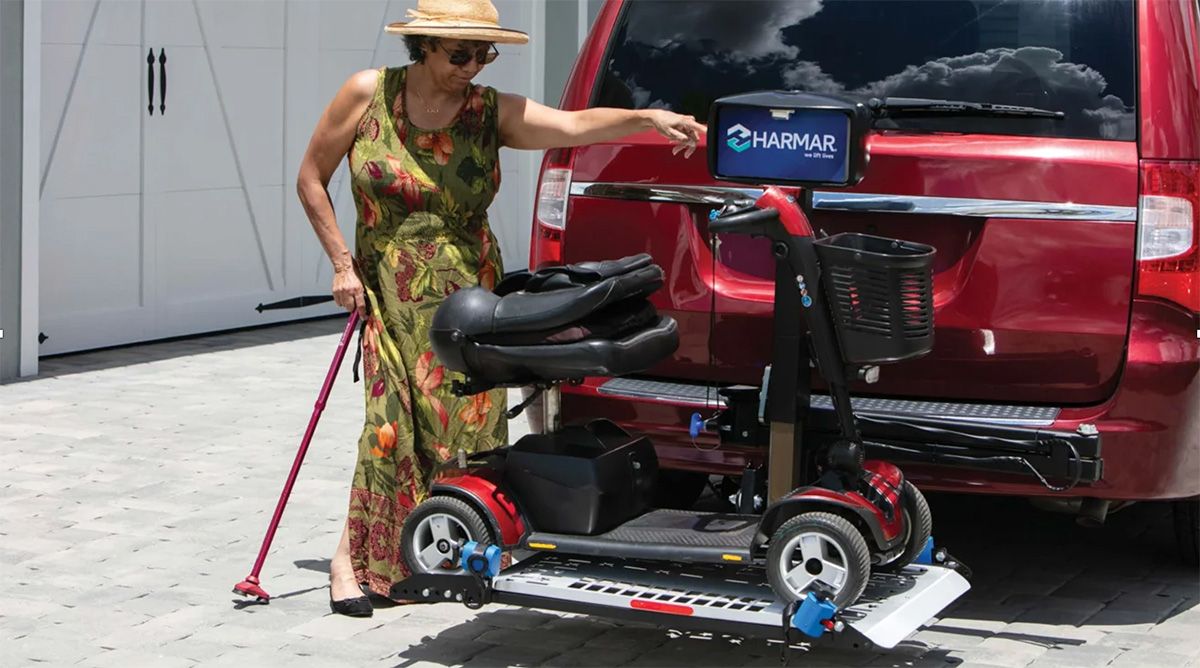
The most common and affordable style, exterior lifts attach to the hitch at the rear of your vehicle.
Best for: Sedans, SUVs, and trucks
Pros:
- Saves interior space
- Easy to install and remove
- Fits most vehicles with Class II or III hitches
Cons:
- Exposes equipment to weather
- Can block rear access
Tip: Consider a weather-resistant cover for year-round protection.
Interior (Hoist & Platform) Lifts

Installed inside your vehicle, these lifts protect your mobility device from rain and road debris.
Best for: SUVs, vans, and pickup trucks
Pros:
- Full weather and theft protection
- Maintains a clean vehicle appearance
- Some models auto-charge while driving
Cons:
- Reduces cargo space
- Requires professional installation
Hybrid Lifts

Hybrid systems combine the best of both worlds — loading from outside and storing inside.
Best for: Vans or SUVs with wide rear access
Pros:
- Full automation
- Weather and theft protection
- Minimal effort required
Cons:
- Higher cost
- Vehicle modifications may be needed
2. Compatibility Checklist
Choosing the perfect lift means matching your vehicle, mobility device, and lift system.
- Weight Capacity: Lift must handle total device weight (including batteries and accessories).
- Hitch Rating: Most exterior lifts need Class II or III hitches.
- Dimensions: Measure cargo height, rear door opening, and ground clearance.
- Future Proofing: Plan for potential upgrades — a slightly stronger lift now saves money later.
Pro Tip: Always schedule a compatibility check with a certified mobility dealer before purchasing.
3. Why Professional Installation Matters
Installing a vehicle lift isn't a DIY project. Professional installation ensures safety, performance, and warranty protection.
Certified installers handle:
- Vehicle and electrical assessments
- Hitch inspection and reinforcement
- Secure wiring and calibration
- Hands-on training and safety checks
Working with local experts (like Mobility Plus Buford) gives you:
- Fast service and repairs
- In-person training and demos
- Ongoing maintenance for long-term reliability
VA Benefits
- VA Benefits: Veterans may qualify for adaptive equipment grants through local VA offices
5. Why You Need a Professional Vehicle Lift System
Transportation challenges affect nearly 70% of mobility device users. Without a lift, you risk:
- Relying on others for transportation
- Missing important events or appointments
- Unsafe lifting that can cause injury or equipment damage
A quality mobility scooter or wheelchair lift restores freedom, comfort, and confidence — letting you go wherever life takes you.
Bottom Line:
The best vehicle lift fits your car, supports your device, and grows with your needs. With expert installation and local service in Buford, GA, your mobility journey can stay effortless and independent for years to come.
10/08/2025

Complete Guide to Mobility Equipment Battery Care
If you rely on a mobility scooter or power wheelchair, proper battery maintenance is crucial for independence and mobility. Whether you use sealed lead acid (SLA) batteries or lithium-ion batteries, following proven practices can extend battery life by 50–100%, saving hundreds of dollars in replacement costs.
This comprehensive guide covers everything mobility device owners need to know about mobility scooter battery care, power wheelchair battery maintenance, and maximizing performance.
Table of Contents
- Understanding Mobility Scooter & Power Wheelchair Battery Types
- SLA Battery Maintenance Guide
- Lithium-Ion Battery Care Tips
- Common Battery Mistakes to Avoid
- When to Replace Your Battery
- Key Takeaways for Maximum Battery Life
- Frequently Asked Questions
Understanding Mobility Scooter & Power Wheelchair Battery Types

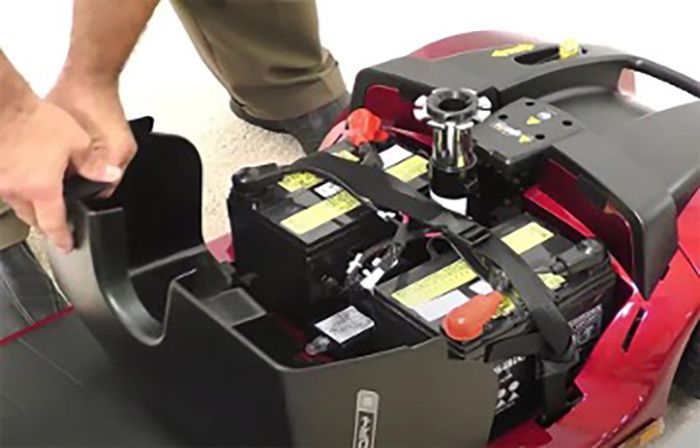
Sealed Lead Acid (SLA) Batteries
SLA batteries are the most common type in mobility scooters and power wheelchairs. They typically last 12–18 months with proper care and cost less upfront than lithium options.
Key characteristics:
- Heavier than lithium alternatives
- Require regular charging cycles
- Sensitive to temperature extremes
- More affordable initial cost
Lithium-Ion Batteries
Lithium-ion batteries are increasingly popular for their lightweight design and longer lifespan (2–5 years). Though more expensive at first, they can offer better long-term value.
Key advantages:
- 50% lighter than SLA batteries
- Longer range per charge
- No memory effect
- Faster charging times
Complete SLA Battery Maintenance Guide
Charge After Every Use
Always recharge after each ride—even short trips—to prevent deep discharges that can permanently damage SLA batteries.
Tip: Plug in immediately after returning home.
Never Store Batteries Empty
Before storing for weeks or months:
- Charge fully to 100%
- Recharge every 2 weeks
- Store in a dry, temperature-controlled space
- Disconnect the battery if storing over 30 days
Use Only Compatible Chargers
Using the wrong charger is the top cause of battery failure. Always confirm:
- Matching voltage specifications
- Manufacturer-approved charger
- Automatic shut-off to prevent overcharging
Avoid Overcharging
When the battery reaches full charge:
- Disconnect within 24 hours
- Never leave it plugged in for days
Temperature Control is Critical
Store and charge batteries between 50–86°F (10–30°C). Extreme cold or heat can permanently damage capacity
Lithium-Ion Battery Care Guide
Avoid Complete Discharge
Partial discharge cycles are best. Recharging at 20–50% remaining capacity can significantly increase lifespan.
Don’t Always Charge to 100%
For everyday use, charge to 80–90%. Reserve full charges for when you need maximum range
Use Original Chargers Only
Generic or rapid chargers produce excess heat and shorten battery life. Use only the charger supplied with your device.
Optimal Storage Charge Level
Maintain 40–60% charge during long-term storage to reduce chemical aging.
Temperature Protection
Lithium batteries don’t tolerate extremes:
- Don’t charge below 32°F (0°C)
- Avoid storage above 95°F (35°C)

Common Battery Mistakes to Avoid
Mistake #1: Waiting Until Empty to Charge
Impact: Shortens lifespan by 50%
Solution: Charge after every use
Mistake #2: Using Universal Chargers
Impact: Risk of overheating or insufficient charging
Solution: Use only approved chargers
Mistake #3: Ignoring Temperature Extremes
Impact: Can permanently damage batteries
Solution: Store and charge in moderate temperatures
Mistake #4: Forgetting About Stored Batteries
Impact: Deep discharge damages cells
Solution: Top off every 2 weeks
Signs Your Mobility Scooter Battery Needs Replacement
- Reduced range (less than 50% of original distance per charge)
- Slow charging times
- Physical damage (cracks, swelling, leaks)
- Age (SLA over 18 months, lithium over 3–5 years)
- Frequent recharging needed
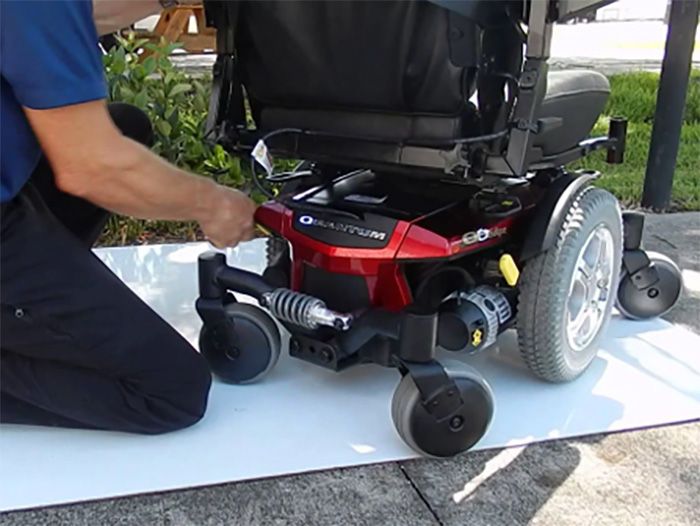
Key Takeaways for Maximum Battery Life
Charge consistently—after every use for SLA, partial cycles for lithium-ion
Use the correct charger every time
Control temperature during storage and charging
Monitor performance and replace batteries as needed
Frequently Asked Questions
Q: How long do mobility scooter batteries last?
A: SLA batteries last about 12–18 months. Lithium-ion can last 2–5 years with good care.
Q: Can I use a car battery charger?
A: No—always use the charger specifically designed for your device.
Q: How often should I charge my battery?
A: SLA—after every use. Lithium-ion—at 20–50% remaining.
Q: Are lithium batteries worth the higher cost?
A: For many users, yes—they last longer, charge faster, and weigh less.
With the right care, your mobility scooter or power wheelchair battery will deliver reliable performance for years to come.
07/15/2025

5 Must-Know Airline Travel Tips for Flying with a Mobility Scooter
Ah, travel season is finally here – sunshine, cruises, and adventures await! If you're flying with a mobility scooter for the first time—or you just want to be fully prepared for a smooth trip—this guide is here to help. With a bit of planning and the right steps, flying with your scooter can be easy, stress-free, and even enjoyable!
Whether it's a family vacation or a cruise departure, here’s what you need to know before heading to the airport.
1. Call the Airline’s Mobility Assistance Line Early
It's best to contact your airline at least 48 hours before your flight. This ensures they’re ready to meet your needs and provide the appropriate support.
Be ready to provide:
- Your full passenger details
- Flight number and destination
- Any specific assistance you’ll need for boarding, gate service, or transfers
Each airline operates slightly differently, so early and clear communication is the golden rule.
2. Prepare Your Mobility Scooter & Battery Details
Airlines require technical info about your device. It’s essential to gather these details in advance:
Key information includes:
- Battery type and watt-hour rating (Wh) — this is especially important if your scooter uses lithium-ion batteries
- Total dimensions and weight of your scooter (with the battery installed)
Tip: Keep this information printed or saved on your phone so you can provide it quickly at check-in.
3. Complete the Airline's Mobility Device Handling Form
Most major airlines now require a Mobility Device Handling Form to safely and efficiently transport your scooter.
Here's what to do:
- Download the form from the airline’s website (e.g., Delta Mobility Device Handling Form)
- Fill it out completely and print multiple copies
- Hand it to staff at check-in, and keep one for backup just in case
This step will significantly speed up the process and minimize questions at the counter.
4. Understand Your Check-In Options
Depending on your airline and airport, you have a few choices for checking in with your scooter:
- Main Ticket Counter Check-In: Great for getting questions answered directly and ensuring your device is tagged properly.
- Curbside Check-In: Available at some airports for added convenience.
Just be sure to inform airline staff that you're traveling with a mobility device so it's handled correctly from the start.
5. Use Gate Check for Easier Boarding
Yes, you can ride your scooter all the way to the boarding gate!
Here's how it works:
- Inform staff at the gate that you'd like to gate-check your scooter
- They'll tag your scooter and load it safely into the plane's cargo hold
- When you arrive, your scooter is usually returned right at the gate
This option gives you the freedom to move comfortably through the airport without needing a temporary wheelchair.
Conclusion: A Little Prep Goes a Long Way
Don't forget—you’ll need to follow these same steps on your return trip. We recommend speaking with airline staff upon arrival to reconfirm return procedures and avoid surprises.
Important: This guide provides general best practices, but always check directly with your airline. Regulations and procedures can vary widely between carriers and may change without notice.
Need Help? Call Us!
For more information or personalized assistance, call us at (770) 800-6681. We're here to help you travel with confidence and comfort.
06/16/2025
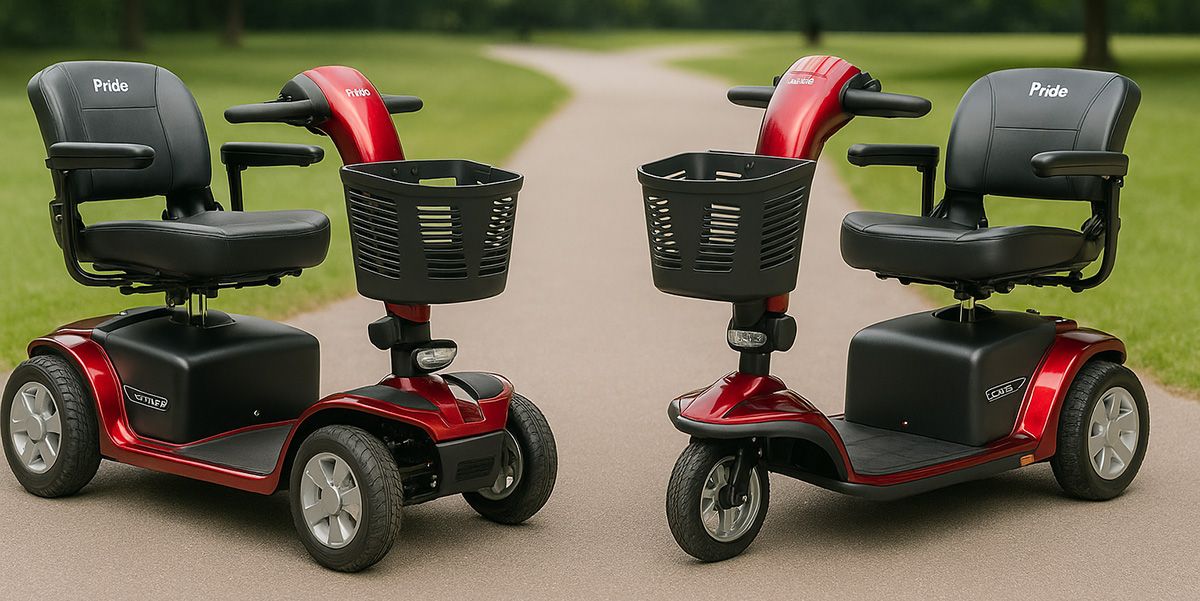
Which Scooter is Right for You: 3-Wheel or 4-Wheel?
At Mobility Plus Buford, we know that choosing the right mobility scooter can feel overwhelming—but it doesn't have to be! Whether you're looking for better maneuverability at home or stability for outdoor adventures, we're here to help you compare 3-wheel and 4-wheel scooters so you can make the best choice for your lifestyle.
3-Wheel Scooters: Agile & Compact
Best for: Tight spaces, indoor use, and users who prioritize ease of turning.
Pros:
- Tighter Turns – Perfect for navigating narrow hallways, stores, or crowded spaces
- More Legroom – Open design gives taller riders extra comfort
- Lightweight & Portable – Easier to transport and store than bulkier models
Cons:
- Less Stable on Rough Terrain – Best for smooth surfaces like sidewalks and floors
- Higher Tipping Risk at Speed – Requires cautious driving on slopes or uneven ground

4-Wheel Scooters: Sturdy & Reliable
Best for: Outdoor use, uneven terrain, and users who need extra stability.
Why Choose a 4-Wheel Scooter?
- Rock-Solid Stability – Four wheels provide a wider, more balanced base, ideal for users with balance concerns or those who need a higher weight capacity
- Smooth Ride on Rough Terrain – Handles grass, gravel, bumps, and slopes with ease—perfect for parks, trails, or uneven sidewalks
- Advanced Maneuverability Features – Some premium models, like the Traveler 2 with Zero Turn technology or the Victory Platinum with Patented EZ Turn, combine top-tier stability with effortless steering
- Great for All-Day Use – The sturdy design reduces vibrations, making longer rides more comfortable
Cons:
- Less Maneuverable Indoors – May require more space to turn in tight areas
- Slightly Bulkier – Can be heavier to transport
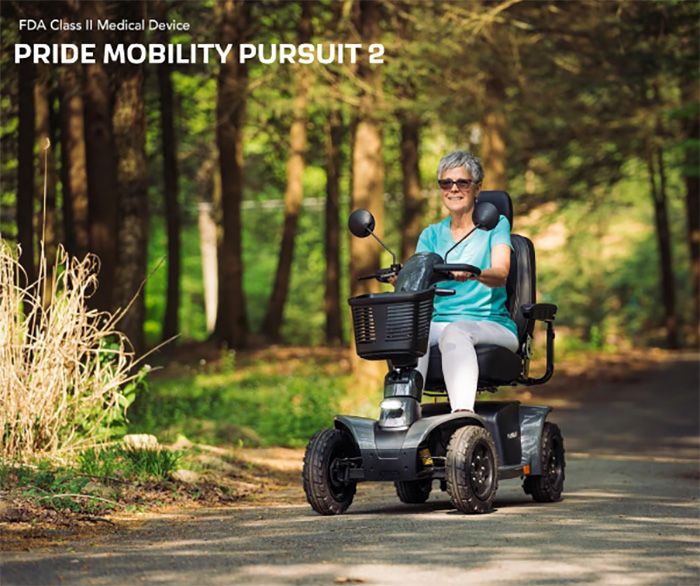
Still Unsure? Try Before You Buy!
The best way to decide? Test drive both! At Mobility Plus Buford, we have:- A fully stocked showroom with 3-wheel & 4-wheel models
- Expert guidance to match you with the perfect scooter
- Personalized test drives so you can feel the difference firsthand
Visit Us Today!
- 1620 Buford Hwy, Ste 102, Buford, GA
- Call (770) 800-6681 to schedule your FREE test drive
Final Thoughts:- Prefer agility? A 3-wheel scooter may be your best fit
- Need stability outdoors? A 4-wheel scooter could be ideal
Either way, we're here to help you regain freedom and confidence in your daily life. Let's find your perfect ride together!
06/03/2025